
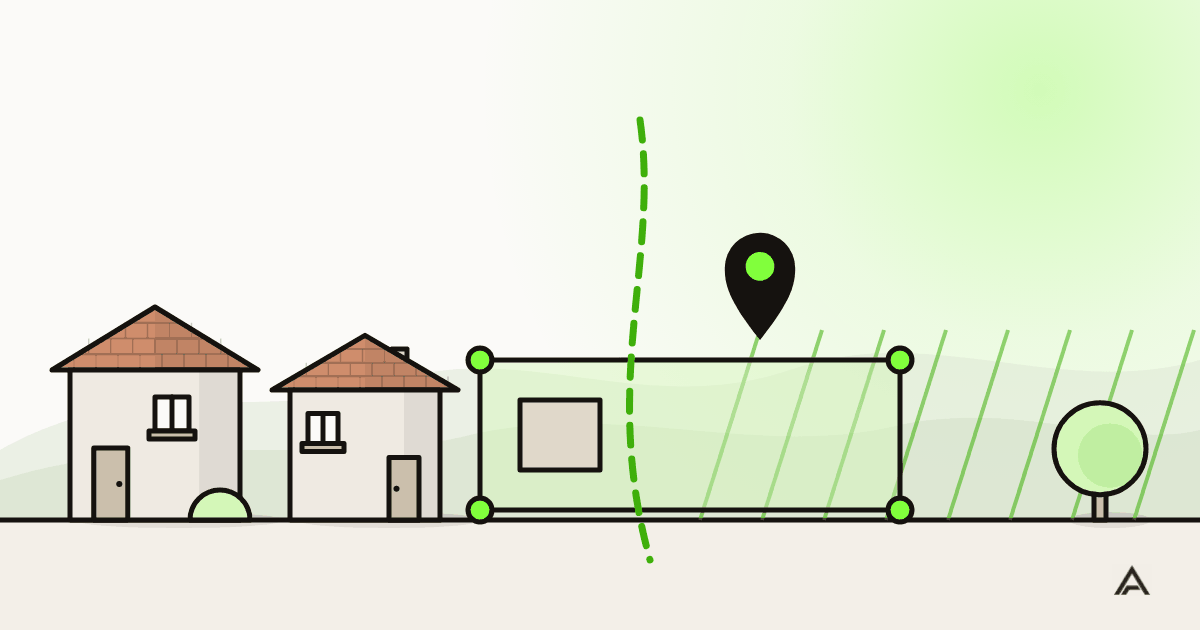
In a sale listing, intravilan sounds like a quality of the land, something a plot either has or lacks. In law it is not a quality of the land at all, but a line drawn on the locality’s plan. That matters when you read the listing: the line can move, it can cut a plot in two, and it does not depend on what the land book says.
Romanian terms are kept in the original: intravilan is the built-up area of a locality, inside the line, and extravilan is everything outside it.
What intravilan means, in the text of the law
The Urbanism Code (Legea 169/2026) defines the intravilan in article 151 paragraph (1): all the built and developed surfaces of the localities in the administrative unit, delimited and regulated by the approved general urban plan (PUG) or by zonal urban plans (PUZ), and within which building works can be permitted.
The last part of the definition is the practical one. The intravilan is, by definition, the place where buildings are permitted. On intravilan land the question is no longer whether you can build, but what: the rules come from the area’s local urbanism regulation, with the indicators we explain on the page about POT, CUT and UTR.
The extravilan, in article 152 paragraph (1), is the area between the administrative unit’s boundary and the intravilan line. Simply put, everything left outside the line.
The line does not follow the fence
Article 151 paragraph (3) says the intravilan line is set by natural features, roads, hydraulic works and other technical works, without having to coincide with the cadastral boundaries of the plots. It is updated through the general urban plan or through zonal plans.
The consequence: a plot can be partly intravilan and partly extravilan. The total area in the listing does not tell you how much of it can be built on. Ask about the intravilan part, not the plot.
What can go up in the extravilan
The extravilan is not a zone where nothing is built, but the list is short and you do not choose it.
| Situation | What the Code says | Article |
|---|---|---|
| How the extravilan is divided | Urbanisation or restructuring macro-zones, agricultural, forestry, renewable-energy and transport zones, and zones where urbanisation is forbidden | 152 para. (2) |
| Which projects are allowed | Those in article 92 paragraphs (2) and (3) of Land Fund Law 18/1991 | 152 para. (3) |
| On what basis they are permitted | The spatial plan or the PUG, if they regulate the extravilan, or a detailed urban project (PUD) during permitting | 152 para. (3) |
| Buildings on agricultural extravilan land | Only for the uses and on the conditions set by law | 167 para. (3) |
| Some agricultural projects | Can be permitted without a new urban plan (art. 92 para. (2) letters c), e), j) and para. (3) of Law 18/1991) | 252 letter g) |
Annex 1 of the Code also defines the typical extravilan building: farm-holding outbuildings are temporary, ground-floor buildings of at most 200 sq m, used by farm workers in isolated extravilan areas to house machinery, small workshops, tools and animals. During farming campaigns they may include temporary lodging. A dwelling house is not a farm outbuilding, whatever the drawings call it. Nor does a container house you live in become a farm outbuilding because it was lifted in by crane: on our reading, it needs the same permit as any house, with the same extravilan limits, as we explain in the permit for a container house. Nor is the shed or garage in a house’s yard; their thresholds are in household outbuildings.
Agricultural land inside the intravilan
The land-use category in the land book (arable, pasture, orchard) and the intravilan regime are two different things. Article 167 paragraph (4) allows on agricultural land inside the intravilan every type of building typical of localities, within the urban plans, unless the law says otherwise. And paragraph (5) says such land is taken out of agricultural use, temporarily or permanently, through the building permit.
So intravilan land recorded as arable in the extract does not need a separate procedure before the design. Removal from agricultural use comes with the permit.
Where your plot’s status is written
The listing is not a source. The urbanism certificate is: article 253 paragraph (4) letter a) requires it to state, under the legal regime, whether the property is intravilan or extravilan, alongside protected areas and building bans. If you have no project yet, you can ask for an urbanism certificate for information, which can be requested before you buy.
For a first, free check, approved plans are increasingly visible on the National Urbanism Geoportal. And if the plot has no road access, intravilan status does not solve that on its own; we covered access in the right of way.
If the land is extravilan and you want a house on it, the route is moving the line, which means an urban plan. What that takes and who pays is in from extravilan to intravilan.
This article is analysis, not legal advice. The provisions cited are from Legea 169/2026, published in Monitorul Oficial no. 661 of 10 August 2026. Check your own situation with the issuing authority.