
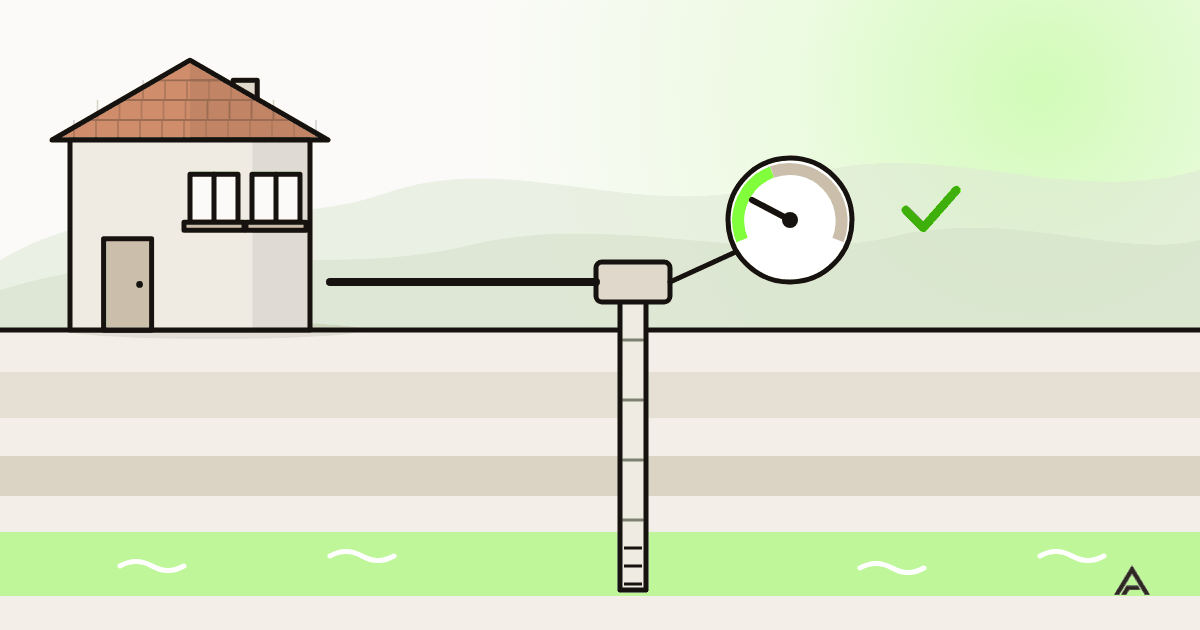
A drilled well (puț forat) or a dug well for your household’s needs requires neither an aviz nor an authorisation from Apele Române, the national water authority, as long as you draw the water without installations or take at most 0.2 litres a second. The 10,000-15,000 lei fine in the Water Law concerns works that needed an aviz or authorisation and were carried out or put into use without them. The Urbanism Code puts a well in no list of works, and its text does not say plainly whether a household well needs a building permit.
At a glance
| Question | Answer | Source |
|---|---|---|
| Does a household well need an aviz from Apele Române? | No, if the water is only for your own household and you draw it without installations or at most 0.2 litres a second | Law 107/1996, art. 9 para. (2), art. 50 para. (3) |
| What does 0.2 litres a second mean? | 12 litres a minute, 720 litres an hour, at most 17.28 cubic metres over a full day | worked out from the legal threshold |
| When do you need an aviz and an authorisation? | Above the threshold, or for any purpose other than the household: the aviz before drilling, the authorisation before use | Law 107/1996, art. 48 para. (1) letters b) and j), art. 50 para. (1) |
| What is the fine without the aviz? | 10,000-15,000 lei for a private individual, 35,000-40,000 lei for a company | Law 107/1996, art. 87 point 1), art. 88 para. (1) letter b) |
| Do you need a building permit? | The Code does not name the well; our reading: the Code’s drilling works are those for research and extraction. Ask the town hall | Legea 169/2026, art. 259 para. (4), art. 357 para. (2) letter b) |
What the Water Law leaves free
Article 9 paragraph (2) of the Water Law (no. 107/1996) says that surface or ground water may be used freely, subject to sanitary and water-quality rules, for drinking, watering animals, watering plants, washing, bathing and other household needs, if no installations are used for this or if the flow drawn does not exceed 0.2 litres/second, exclusively to meet the needs of one’s own household. Article 50 paragraph (3) takes exactly these uses out of paragraph (1), that is, out of the water-management aviz and the water-management authorisation.
Besides compliance with sanitary and water-quality rules, the exemption has two conditions, and you must meet both. The first is purpose: the water is for your house, yard and animals, not for a guesthouse, a greenhouse whose produce you sell, or a car wash. The second is flow. A bucket drawn by hand has no limit, while a pump must not draw more than 0.2 litres a second. The threshold sounds small, but it means 12 litres a minute or 720 litres an hour; at that flow, a whole day of pumping would give 17.28 cubic metres.
The same line appears in the penalties. Article 87 point 3) makes it an offence to use ground water without complying with the water-management authorisation, except for meeting the needs of one’s own household.
The pump or the water you draw
The law looks at the water you draw and the procedure approved by the ministry looks at the pump; our reading, explained below, is that the law decides. The law, as worded by Emergency Ordinance 52/2023, speaks of the flow drawn, the water you actually take. The authorisation procedure, approved by Order 891/2019, exempts household supply in article 5 letter a) when no installations are used or installations with a capacity of up to 0.2 l/s are used, so it looks at the pump.
Both texts measure a flow, not a quantity. If the pump’s flow is given in cubic metres per hour, the 0.2 litres a second threshold means 0.72 cubic metres per hour, and a pump that delivers more exceeds the threshold every time it runs, however rarely you switch it on. The difference between the law and the order matters only when the water actually drawn is below the pump’s capacity, for example when the flow is throttled with a valve. Our reading is that the law then decides, being the higher act and the more recently worded text: what counts is the flow drawn, not the pump’s capacity. If your pump exceeds the threshold and you want certainty, ask the county water-management system (sistemul de gospodărire a apelor) for a written answer.
When you need the aviz and the authorisation
A well that draws more than 0.2 litres a second, or serves anything other than the household, falls under article 48 paragraph (1). Letter b) names works using water, with the related structures and installations: drinking, industrial and irrigation water supply, and letter j) works of prospecting, exploration/extraction by land drilling. For these, article 50 paragraph (1) requires two separate acts: the water-management aviz, to carry out the works, and the water-management authorisation, to use them.
The aviz is issued by the river-basin water administrations or, within the limits delegated to them, by the county water-management systems. For water supply from a deep underground source, the content standard approved by Order 828/2019 (annex no. 2, article 27) requires documentation with a hydrogeological study, plans of the works in the area (other boreholes, intakes, waste dumps, pollution sources), technical construction data and proposed equipment. The procedure in the same order adds that the aviz lapses if the works do not start within 2 years (article 27 of the procedure).
Examples of uses that fall outside the exemption even at a small flow: water for a guesthouse, irrigating a crop you sell, or a workshop. The law ties the exemption to one’s own household, and for anything else the aviz rule stands.
What the Urbanism Code says about drilling
The Code (Legea 169/2026) mentions water wells in no list of works. The word “foraje” (drilling) does appear, though, in article 259 paragraph (4), among landscaping works (lucrări de amenajări): “land research/prospecting, drilling, excavations”. And paragraph (6) requires a building permit for all construction works except those for which a notification is enough or no formality is needed.
The context points elsewhere. Article 371 paragraph (4) letter e), which classifies the same works, lists them next to research for topographic studies, geological prospecting, geotechnical, geophysical, hydrological studies. Article 252 letter d) speaks of drilling and excavations needed for geotechnical studies for extraction works, and article 357 paragraph (2) letter b), where they are made offences, of “drilling and excavation works needed for geotechnical studies” and of quarries, gravel pits, gas and oil extraction. Articles 259 paragraph (4) and 369 paragraph (4), by contrast, list drilling with no purpose at all. Our reading is that the Code’s drilling works are research and extraction works, and a household well is named nowhere. The text does not exclude the well outright, though, and some town halls (primării) may ask for an urbanism certificate or a permit; ask yours before you call in the rig. What a permit for landscaping works requires and how long it takes is on the page about the landscaping permit.
Distance from the septic tank and the stable
Where the well goes is governed by separate, public-health rules. The norms approved by Order 119/2014, in article 27 paragraph (2), place a well at least 10 m, measured radially, from stables, coops, manure platforms, emptiable septic tanks (fose septice vidanjabile) and latrines. If you dig the well first and the septic tank later, article 34 of the same norms applies, which places an emptiable septic tank 10 m from the water source: the distance is the same, the order does not matter.
The septic tank’s other distances, and how they are measured, are in the article on the legal distance of a septic tank, and those of stables and coops from homes in the one on how far from houses you can keep animals.
What you risk without the papers
For a well, the Water Law fine is the one that matters. Article 87 point 1) makes it an offence to carry out or put into operation works built on water or connected with water without an aviz or authorisation, and article 88 paragraph (1) letter b) punishes it with 10,000-15,000 lei for a private individual and 35,000-40,000 lei for a legal entity. The offence is found by Apele Române inspectors, Environmental Guard commissioners and the other authorised persons in article 90 letters b) and c). The fine concerns works that needed an aviz: a household well under the threshold does not need one, so it does not fall here.
On the urbanism side, the Code sets no amount for the drilling works in article 357 paragraph (2), because paragraph (4) sets fines only for the offences in paragraph (1). If the town hall does treat the drilling as a landscaping work that needs a permit, carrying it out without one falls under article 357 paragraph (1) letter b), with a fine of 50,000-1,000,000 lei (paragraph (4) letter b)). The Code’s fines for works without a permit in general are on the page about fines for building without a permit.
The Water Law’s consolidated form of 23 July 2026 shows no change since July 2024 to the articles cited: the 0.2 litres a second threshold has the wording given by Emergency Ordinance 52/2023, and the fines in article 88 keep their 2023 form. The only 2026 law amending it, Law 155/2026, changes only articles 85 and 85^4, on the funding of Apele Române’s investments.
Before you call the drilling company
- Decide what the water is for: only your house and yard, or also an activity that earns you money.
- Find the flow of the pump you plan to fit and compare it with 0.72 cubic metres per hour.
- If you fall outside the exemption, apply for the water-management aviz before drilling and the authorisation before you use the water.
- Measure the distance to your septic tank and your neighbour’s, to the stable and to the manure platform.
- Ask the town hall whether it wants an urbanism certificate for the drilling.
This article is analysis, not legal advice. The provisions cited are from the Water Law no. 107/1996, in its form consolidated on 23 July 2026, from the procedures approved by Order 828/2019 and Order 891/2019, from the norms approved by Order 119/2014 and from Legea 169/2026, published in Monitorul Oficial no. 661 of 10 August 2026 (with the rectification in Monitorul Oficial no. 862 of 14 October 2026). Romanian legal terms are kept in the original where the English would be misleading. Check your own situation with the issuing authority.