
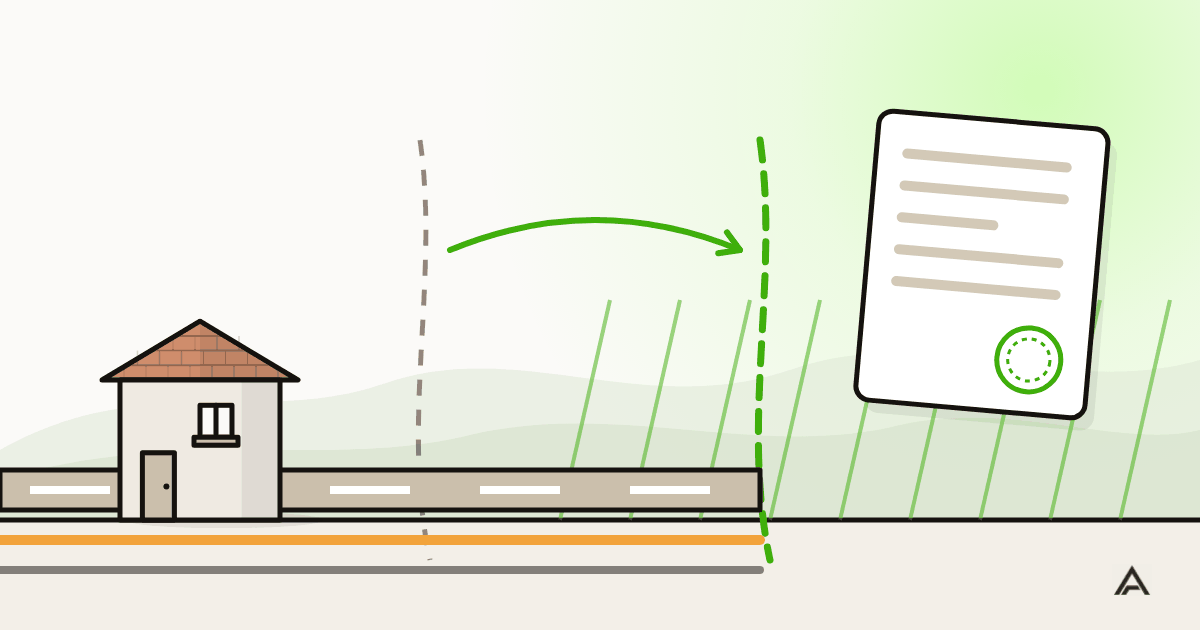
Anyone asking how much it costs to move land from the extravilan into the intravilan usually expects a fee and a deadline. The Urbanism Code sets neither a fee for the move itself nor a deadline. It has a list of conditions instead, and the most expensive of them is not paperwork but infrastructure.
Romanian terms are kept in the original: the intravilan is the built-up area of a locality, where building permits are issued, and the extravilan is the land outside it.
One route: the urban plan
Article 153 paragraph (1) of Legea 169/2026 says agricultural extravilan land, and land fitted with land improvements, enters the intravilan on the basis of the general urban plan (PUG) or of zonal urban plans (PUZ). For that plan, the opinion on the land’s quality class must be issued beforehand by the agriculture ministry.
There is no individual request through which the town hall moves your plot across the line. The line moves through a PUG or a PUZ, with their own approval process ending in the local council, which we describe on the page about PUG, PUZ and PUD.
Who can initiate the PUZ
This is the first surprise. Article 151 paragraph (7), second sentence: extending the intravilan outside the urbanisation zones set by the general urban plan can be done only through urban plans initiated by the public authority.
For an owner, that changes the order of the questions. The first is not what the PUZ costs, but whether the commune’s PUG put your land in an urbanisation zone. If it did not, a PUZ you initiate cannot move the line there, however much you pay for it. Annex 1 of the Code defines urbanisation macro-zones as extravilan areas where the intravilan can be extended in a controlled, phased way.
What the documentation must show
| Condition | Article |
|---|---|
| Extension depends on the commune’s technical and financial capacity to provide public infrastructure and facilities, whoever initiates the plan | 151 para. (4) |
| A study assessing economic and social impact and the cost of servicing the area | 151 para. (7) |
| The proposal rests on population density, economic trends and the local budget’s capacity to maintain the investment | 153 para. (3) |
| The plan includes an investment programme and action plan: roads, networks, grading, values, funding sources, phases | 153 para. (3) |
A PUZ for a single house at the edge of a commune must therefore answer questions nobody used to ask: who builds the road, who brings water and sewerage, and with what money.
Who pays for the infrastructure
Article 151 paragraph (8) answers directly for private investors who want to extend the intravilan into unserviced areas: they cover the full cost of the extension and show the technical solutions that let the area work independently, or they negotiate a joint funding plan with the town hall. Alternatively, extension concentrates in areas already serviced or about to be.
If costs are shared in a partnership, article 153 paragraph (3) requires the investment programme to show what falls on the town hall and what the investor pays, adopted by local council decision and with the investor’s notarised commitment.
Two more costs come after approval. Article 63 paragraph (3) provides for local area-servicing taxes on those inside a PUZ that moves land from the extravilan into the intravilan, including people who did not initiate the plan, according to the benefit they get. We covered the tax in the local servicing tax. And paragraph (4) names the minimum obligation of whoever initiated the PUZ: water, sewerage, electricity and roads.
After approval
The town hall sends the approval decision and the documentation to the cadastre office, so the use of the properties is updated in the land book (article 153 paragraph (2)). Check your extract a few weeks later; if it has not changed, ask the town hall for proof that it was sent.
And read the plan’s term. Article 151 paragraph (9) deals with a PUZ of limited validity that brought an area into the intravilan and has expired: at the owners’ request, the local council may decide to keep the land in the intravilan. May, not must. Land brought in on a time-limited plan has no guarantee of staying there if you do not build in time.
From here on it is the usual permit file, on land you can now read as intravilan. And if the land must be split first, the certificate for that is in cadastral operations.
This article is analysis, not legal advice. The provisions cited are from Legea 169/2026, published in Monitorul Oficial no. 661 of 10 August 2026. Check your own situation with the issuing authority.