
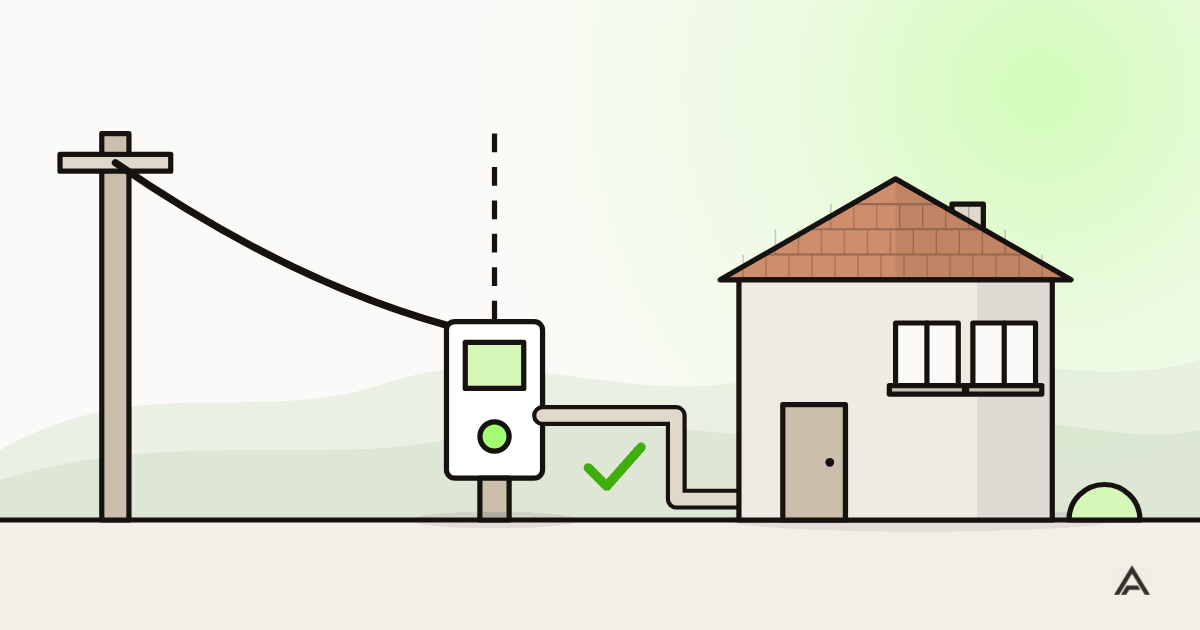
The question usually comes in one of two forms. In the first, you own a plot and want power on it before the house has its permit. In the second, the house is already up, the permit is missing, and the supplier will not connect you. The Urbanism Code (Legea 169/2026) answers each one differently, and the answer turns on a word that almost every forum explanation skips: aferente, meaning “serving” or “belonging to”.
What needs no formality at all
Article 299(2)(b) point 3 puts on the list of works that need neither a permit nor a notification: “service connections and external connections of any kind serving buildings, within the boundaries of the property” (branșamentele și racordurile exterioare, de orice fel, aferente construcțiilor, în limitele proprietății). Point 9 of letter (a) in the same paragraph adds repairs to those connections, also within the property, for existing buildings outside protected areas.
Point 3 sets two conditions and makes one clarification:
| Condition | What it means in practice |
|---|---|
| “serving buildings” | The connection serves a building. The text says nothing about an empty plot |
| “within the boundaries of the property” | The part on your land. Work done in the street is not covered |
| “of any kind” | Electricity, water, sewer, gas: the point makes no distinction between networks |
Annex 1 to the Code defines a building’s installations as the equipment inside the property boundary, from the service connection to the users, and says they are authorised together with the building or, where appropriate, separately. The exemption is therefore tied to a building that the connection serves.
On a plot with no building
Here the Code has no point that exempts you. If there is no building on the plot, there is nothing for the connection to “serve”. The general rule in art. 259(6) still applies: a building permit is mandatory, except for works the law moves to notification or exempts from every formality.
The route the Code describes for power on a plot where you are about to build is the site set-up (organizarea execuției). The site set-up permit can be requested together with the building permit or separately, by the general contractor (art. 291(3)), and its technical report also describes the temporary connection to local utilities (art. 291(5)(c)). The site set-up project comes with the approvals for the utilities the site needs (art. 517(5)). The details are in the article on site set-up.
For a plot where you are not building anything, say a garden or an irrigation pump, the Code gives no written answer. The right way to ask is an application for an urbanism certificate that describes exactly what you want to supply.
The part in the street
The point 3 exemption stops at the property line. For a new house, the connection work on public land appears in the permit project: Annex 2 to the Code (the standard content of the project for a building permit) requires a plan marking the service connections executed on public land, and Annex 3, the simplified version for a single rural house, also requires a site plan showing that work. The plan marks the routes, dimensions, manholes and meter boxes. The street route is therefore drawn together with the house, not after it. Where public networks are missing, Annex 2 asks for the property’s own installations to be shown, especially water and sewer.
For works that concern only the connection to the local networks, the road administrator’s agreement or permit is issued by the local authority at the request of the project’s owner, taking into account the network operator’s legal rights. The house’s building permit and the road administrator’s agreement for the connections are issued at the same time, and if the agreement for one utility cannot be issued, that does not hold up the other permits (art. 267(1)). Also together with the building permit, the applicant requests the approvals of the utility suppliers in the area: electricity, water and sewer, gas, waste collection, as the urbanism certificate required (art. 250(3)).
The Code is silent on which documents the distribution operator asks for when you apply for a connection, and on how quickly it answers. Ask your operator: those are energy-sector rules, not the Code’s.
The house without a permit, and the supplier
The second case has a direct answer. Article 357(1)(c) makes it a minor offence (contravenție) to approve “the supply of urban utilities, following connection works to networks, for buildings erected in breach of the legal provisions” (aprobarea furnizării de utilități urbane, ca urmare a executării lucrărilor de branșamente și racorduri la rețele pentru construcții realizate cu nerespectarea prevederilor legale). The fine runs from 30,000 to 50,000 lei (paragraph (4)(c)).
The text does not name who approves. The act it describes, though, is approving the supply, not building, so a supplier who refuses to connect a house without a permit is reading its own risk correctly. For the owner, the relevant offence is letter (b), building without a permit, with a fine of 50,000 to 1,000,000 lei (paragraph (4)(b)); in a protected area, the same act is a criminal offence (art. 356(1)(a)). In short, the connection is not solved separately from the house: the order is the regularisation permit first, where the Code allows one, then the utilities.
For houses on wheels and containers, where the question comes up most often, we wrote separately about containers and mobile homes.
At handover, the connections count
For developments of individual and collective housing, the acceptance at completion of works can only take place together with the acceptance of the service connections to the utility networks, except where the law expressly provides otherwise (art. 528(4)). The same rule covers public-use buildings and access roads. If you are buying from a developer, this matters to you as well; the developer’s duties are in what the Code asks of a developer.
Check before you call the supplier
- Is there a building on the plot? If so, the connection in the yard needs no formality.
- Does the work go beyond your land? For a new house, the street part belongs to the house project.
- Are you building now? Site power goes through the site set-up.
- Is the house missing its permit? Sort out the house first; whoever approves the utility supply risks a fine (art. 357(1)(c)).
The connection in your yard is only one point in a longer list of exempt works; the rest are on the page about works without a building permit.
This article is analysis, not legal advice. The provisions cited are from Legea 169/2026, published in Monitorul Oficial no. 661 of 10 August 2026. Romanian legal terms are kept in the original where the translation would lose precision. Check your own situation with the issuing authority.