
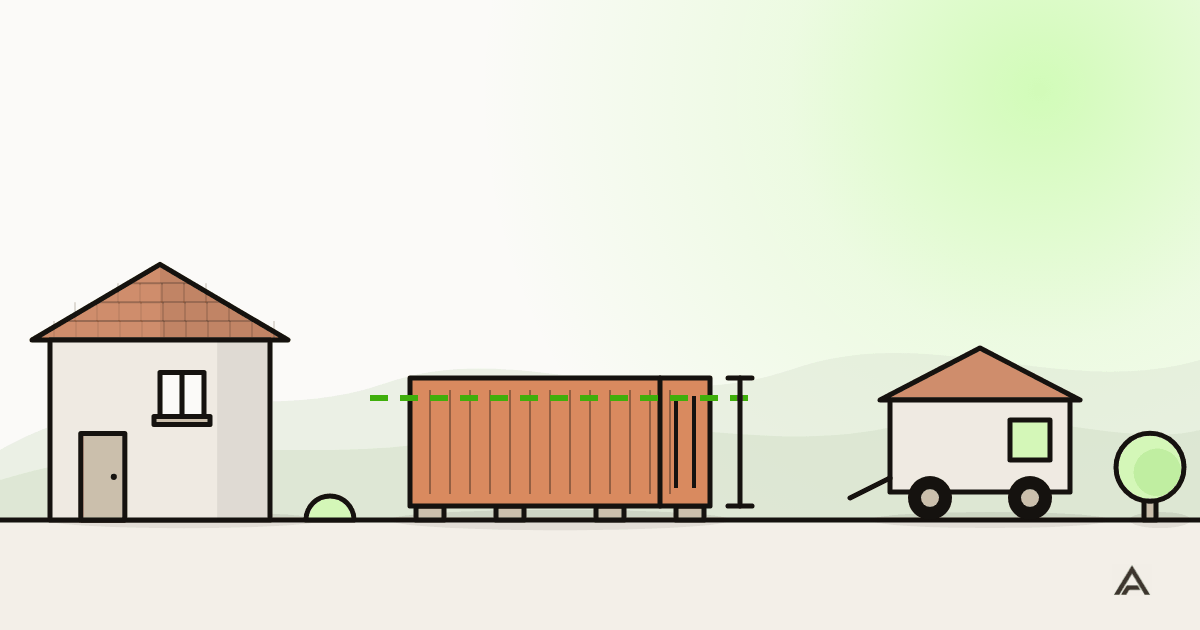
A container house goes through the same procedure as any other house: as a rule you need a building permit, and for a small house in a rural area, notification with a design can be enough. The Urban Planning Code (Legea 169/2026) has no separate regime for container homes, and for a home on private land there is no siting permit. Being lifted in by crane and having no foundation does not take it outside the law either.
At a glance
| What you put on the land | What you need | Where it says so |
|---|---|---|
| A container house, as a home | Building permit, with a design | Art. 259 para. (2) lit. a) and para. (6), art. 369 para. (2) |
| A small house in a rural area, ground floor, at most 150 sq m gross floor area | Notification, with a design, if you meet every condition | Art. 294 para. (2) lit. a) item (ii) |
| A container as a shed next to the house, in a rural area | No permit and no notification only up to 20 sq m in total and 2.5 m high (a standard container is 2.59 m); notification up to 50 sq m in total, not in metropolitan areas | Art. 299 para. (2) lit. c), art. 294 para. (2) lit. a) item (i) |
| A temporary container, with an end date | Building permit; the construction’s lifetime is written in the permit, at most 5 years | Art. 259 para. (2) lit. c) and para. (4), art. 368 para. (3) lit. d) |
| A sales caravan or vending machine, at most 12 sq m, no connection other than electricity | Siting notice (aviz de amplasare); a home is not on the list | Art. 300 lit. f) |
| A house on wheels you live in | The Code has no rule; you ask through an urban planning certificate | - |
A container house without a building permit: is it possible?
With no paperwork at all, no, not if you live in the container. Without a building permit there is one case only: a small house in a rural area, by notification, with a design (article 294). Adverts that promise container houses with no building permit usually rest on the missing foundation, or on the idea that a container is movable property. The Code’s definition of a construction does not require a foundation (Annex 1), and article 369 paragraph (2) treats constructions meant to shelter people as buildings.
Apart from the notification for a house, for a container in your garden two situations stay outside the permit, both in rural areas: the outbuilding of at most 20 sq m in total and 2.5 m high, from the list in article 299 (sheds, summer kitchens, gazebos and the like), and constructions outside the house of at most 50 sq m in total, which go by notification. Both concern constructions outside a dwelling, and Annex 1 describes household outbuildings as complementary to living; on our reading, neither covers a house.
Which legislation applies to a container house
The same law as for any construction: the Urban Planning Code, in force since 25 August 2026. There is no law on container houses. In the whole Code, containers are named three times: once under site works (article 259 paragraph (4)) and twice in article 346, on the constructions of defence and public order institutions.
The rest comes from the general rules: the definitions of a construction and of a building, the permit rule in article 245, the exceptions in articles 294, 299 and 300, and the fines in article 357. We take them in turn.
No foundation does not mean no construction
Annex 1 of the Code defines a construction as any structure fixed in or on the ground, designed for a technical, economic, social or ecological function. The definition does not require a foundation, it says in or on the ground. It does require the structure to be fixed, and whether a container on four concrete blocks is fixed is exactly the open question. On our reading, a container connected to utilities, resting on blocks and used as a home is at risk of being treated as fixed on the ground. Article 369 para. (2) calls buildings the constructions meant to shelter people, animals or materials, so a container you live in belongs there.
The basic rule is still art. 245: construction works are carried out on the basis of a permit, with the exceptions the Code lists. The exceptions in paragraph (2) are notification and works with no formality at all, both described on the page about works without a building permit.
The siting notice exists, but not for the container in your garden
The expression aviz de amplasare (siting notice) appears in the Code in two articles and one definition.
- Article 300 allows, without a building permit, on the basis of a siting notice, a closed list, including: bike racks, charging points, mobile eco toilets, waste collection points, road signage, newspaper or flower kiosks, caravans and vending machines of at most 12 sq m, placed directly on the ground, without foundations and without utility connections other than electricity, temporary set-ups for shows, fairs or ice rinks. A home is not on the list.
- Article 346 is titled for the authorisation of special-purpose construction works and concerns the defence, public order and national security institutions. Paragraph (4) mentions relocatable or mobile constructions, containers and cabins, without foundations, on the basis of a siting notice. Paragraph (5) states expressly that the notice is issued by those institutions, for their own premises. Paragraph (4) does not repeat that, but it sits in the same article; on our reading, it is not a route open to a private owner.
- Annex 1 defines the siting notice as a notice from the local authority, issued under local regulations, for constructions or site works that are not subject to authorisation. The definition creates no exemption; it applies only to what is already exempt.
If someone promises you a siting notice for a container home, ask which article it is based on.
Where containers appear in the Code: under site works
Article 259 para. (4) includes in site works (lucrări de amenajări) the creation of “construcții provizorii/temporare de tipul: campinguri, containere, tabere de vară sau corturi evenimente”, and art. 371 para. (4) lit. c) places provisional or temporary constructions under site works, without naming containers again. Paragraph (2) of art. 259 says the building permit is also issued for site works.
In other words, a container does not leave the permit system by being listed as a site work; it only gets documentation with different content, described on the page about the site works permit.
The Code does not say whether a container used as a home goes through site-works documentation or through the ordinary design for a building. The list in art. 259 puts it next to campsites and camps, that is, next to seasonal uses. For a permanent home, our reading is that the town hall will ask for the building design.
Temporary means with an end date, not without papers
Annex 1 defines temporary constructions as authorised as such, with a limited lifetime stated in the building permit. Article 368 para. (3) lit. d) caps that lifetime at 5 years, with the exceptions provided by the Code. The list in the annex is open: kiosks, stalls, cabins, canopies, pergolas, commercial caravans and the like. On our reading, all the examples are objects in public or commercial space; a home is not among them.
In practice: a container authorised as temporary has an expiry date written into its permit. Keeping a provisional construction past that date, where it affects the public domain, is a minor offence (art. 357 para. (1) lit. e)).
A modular or container house is a house
Modules built in a factory and mounted on a foundation are a new, permanent building, and the procedure is the same as for any house. The same goes for a house made of shipping containers set on a foundation.
The design required is the one described on the PAC page. For a whole house there is only one simplified route, in art. 294 para. (2) lit. a) item (ii): notification for a single detached house with its own access and plot, ground floor or semi-basement and ground floor, with no basement, of at most 150 sq m gross floor area, in the built-up area of a rural locality, outside protected areas and monument protection zones, in line with the planning documentation. The design can be of two kinds:
- one of the “proiecte-tip puse la dispoziție” (standard designs made available) by public authorities, resulting from design competitions;
- an individual design drawn up by an architect with signing rights and structural and building-services engineers, following the Romanian Order of Architects’ architecture guide for rural areas, endorsed by the county chief architect.
A modular house maker’s catalogue is not a standard design. Such a house can only use the second route, with an individual design and all the conditions above.
A container in the yard or garden as a shed: watch the height
For an outbuilding next to a house, the Code has two thresholds, both in rural areas only and with all their conditions:
- with no formality, outbuildings of at most 20 sq m in total, at most 2.5 m high, without a foundation, provisional, demountable, on a timber or metal structure (art. 299 para. (2) lit. c)); the outbuilding must still be declared on your own responsibility, for tax (para. (12)), and the completion reception stays mandatory (para. (5));
- by notification, constructions outside the house of at most 50 sq m in total, in the built-up area, outside protected areas and outside rural localities in metropolitan areas (art. 294 para. (2) lit. a) item (i)).
The full conditions are in household outbuildings.
A 20-foot container in its usual version (ISO 668, type 1CC) measures about 6.06 x 2.44 m, so roughly 14.8 sq m, with an external height of 2.59 m. It fits within the 20 sq m but exceeds the 2.5 m height by 9 centimetres. Annex 1 measures building height from natural ground level, so the blocks under the container add to the 2.59 m. What the Code leaves open is whether the 2.5 m threshold means total height or facade height, which the annex defines separately; for a flat-roofed container the difference is small. On paper, the usual container does not qualify. A 40-foot container is about 29.7 sq m and exceeds the 20 sq m threshold anyway.
Houses on wheels and caravans
The Code has no rules for vehicles used as homes. Caravans appear in it only as commercial caravans (Annex 1), as vending caravans (art. 300) and in camps of tents, cabins or caravans, whose organisation without a permit or without prior notification is a minor offence (art. 357 para. (2) lit. c)). Separately, small campsites of light construction for at most 20 people can be set up by notification, provided they have access to local public utilities: water, sewerage, electricity, waste collection (art. 294 para. (4) lit. a)).
For a house on wheels parked on your land and used as a home, with utility connections, the Code has no written rule. What it has is the definition of a construction, which catches a structure fixed in or on the ground. We cannot say with certainty how the town hall will classify a registered trailer, so the right way to ask is an application for an urban planning certificate, with the purpose described exactly.
Utility connections and the fine
The connection is usually where the problem shows. Approving utility supply for a construction built in breach of the law is itself a minor offence, fined at 30,000-50,000 lei for whoever approves it (art. 357 para. (1) lit. c) and para. (4) lit. c)). Carrying out the works without a permit falls under letter b), with a fine of 50,000 to 1,000,000 lei (para. (4) lit. b)).
The other sanctions are on the page about fines for unpermitted construction.
If the land is not yours, temporary constructions can also be built under a personal right (drept de creanță), for example a lease, with the owner’s consent (art. 245 para. (4) lit. a)). The limits of that route are in what title to the land the permit needs.
What to write in the certificate application
- What it is: a home, an outbuilding or a temporary construction, and for how long.
- The real dimensions, including the container’s external height.
- How it sits on the land: foundation, slabs, wheels, and which utility connections it has.
- Whether the plot is in the built-up area, in a rural locality and outside a protected area.
The town hall’s answer to an application written this way tells you whether you need a permit, a notification or neither, before you buy the container.
This article is analysis, not legal advice. The provisions cited are from Legea 169/2026, published in Monitorul Oficial no. 661 of 10 August 2026 (with the rectification in Monitorul Oficial no. 862 of 14 October 2026). Romanian legal terms are kept in the original where no exact English equivalent exists. Check your own situation with the issuing authority.