
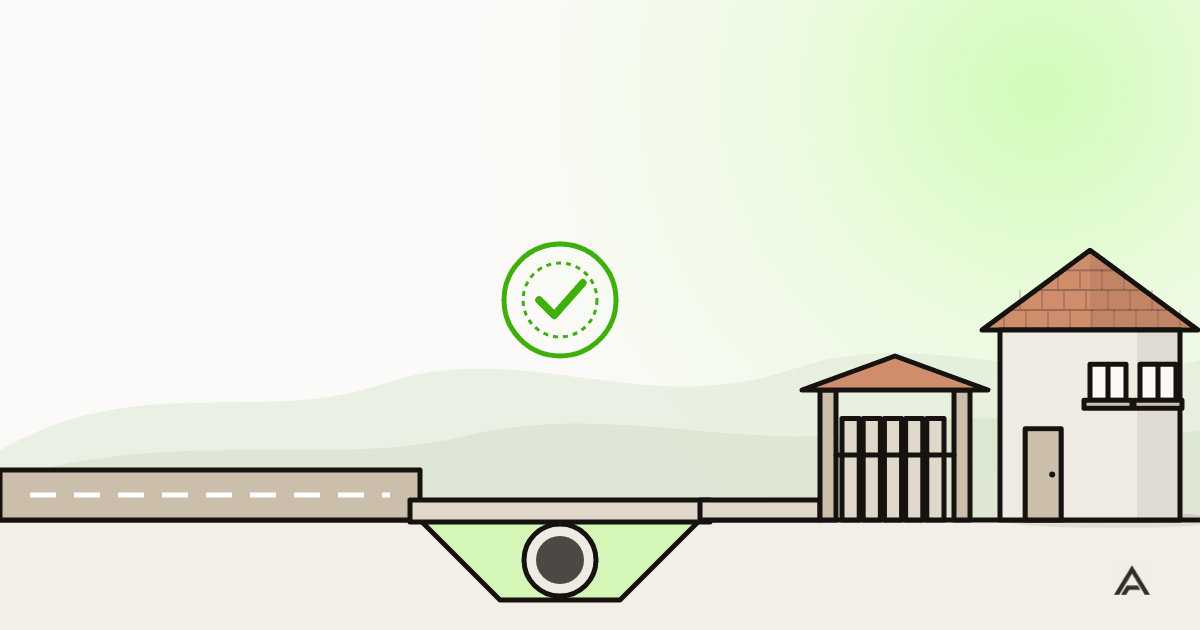
A culvert (podeț) for access to your yard is built over the roadside ditch, and both the ditch and the culvert are part of the road, not of your land. That is why a verbal understanding with the neighbours or the mayor is not enough: Government Ordinance 43/1997 on roads requires the written prior consent and siting and/or access permit of the road’s administrator, which for local roads is the local council. Our reading: you probably also need a building permit, because the Code gives a culvert no exemption. Without the permit, the culvert is removed at your expense, and the fine is between 2,000 and 6,000 lei.
In brief
| Question | Answer | Source |
|---|---|---|
| Who owns the ditch in front of the gate? | It is part of the road, as culverts are | OG 43/1997, art. 2(3) |
| What does a new access onto the road need? | The prior consent and the siting and/or access permit, from the road administrator | OG 43/1997, art. 46(1) |
| Do you also need a building permit? | Probably yes: the Code does not exempt a culvert | Legea 169/2026, art. 245, 294, 299 |
| Do you pay a fee for using the road? | No, if you use the road zone only to reach your property | OG 43/1997, art. 46(9) |
| Who maintains the culvert? | You, as the beneficiary named in the permit | OG 43/1997, art. 47(8) |
| What happens without a permit? | A notice to remove it within 5 days and a fine of 2,000-6,000 lei | OG 43/1997, art. 46(4), art. 61(1)(a) |
| How far from the road does the fence go, in a village? | At least 13 m from the axis of a national road, 12 m for a county road, 10 m for a communal road | OG 43/1997, art. 19(4) |
Who owns the ditch in front of the gate
Ordinance 43/1997 lists what is part of a road: besides the carriageway, it includes bridges, culverts, ditches, gutters, pavements and other works (article 2(3)). For streets, the street zone also includes ditches and gutters (article 19(1)).
The practical consequence is simple. When you lay pipes in the ditch and cover them to drive into your yard, you are building on the road, on land you do not own. The decision is not yours, and not your neighbour’s either, even if they did the same ten years ago.
Which approvals you need from the road administrator
Article 46(1) requires, for access ways, works and installations in the public road zone, in addition to the building permit, where applicable, the prior consent and the siting and/or access permit for the public road zone, issued by the administrator of that road. The duty to apply is yours, as the beneficiary (paragraph (3)).
Who the administrator is depends on the road: the county council administers county roads, and the local council local roads (article 22). The conditions for issuing the consent and the permit are set by order of the transport minister for national roads, by decision of the county council for county roads and by decision of the local council for local roads, with exceptions for stretches inside towns (article 46(2)). The form, the documents and the timeline therefore come from the administrator of the road in front of your gate.
One rule spares you, the other binds you. Anyone who uses the road zone only to reach their property does not pay the fees for use and access (paragraph (9)). Building, maintaining and repairing the access onto the road remain your job, however, as the beneficiary named in the consent and the permit (article 47(8)). A blocked culvert that floods the road is therefore your problem.
And the building permit?
Probably yes. The Urbanism Code does not exempt a new culvert over the roadside ditch, and the ordinance asks for the building permit where applicable. The Code’s rule is that building work is done on the basis of a permit, and the exceptions are the notification route and works needing no formality at all (article 245(1) and (2)).
The list of works needing no formality in article 299 includes outdoor service connections of any kind, but only within the limits of the property (paragraph (2)(b), point 3), and access steps inside the property (point 4). Neither this list nor the notification list (article 294) mentions culverts or accesses onto the road. Our reading: a new culvert over the roadside ditch has no exemption in the Code, so it needs a permit; ask the town hall before you build it.
For a new house, the access goes into the house’s file. When issuing the permit, the town hall also considers pedestrian and vehicle access on the plot (article 250(2)(c)), and the application includes, where applicable, the project for the road administrator’s consent or permit (article 262(1)(i)). Which approvals the town hall actually asks of you is shown in the certificat de urbanism, where the consent for connecting to the road network may also appear (article 266(2)(a)).
The traffic police approval is not needed for a house that generates fewer than 5 small vehicles a day, with no heavy goods vehicles, if the street is category III or IV, is not in the area of a roundabout and is not less than 25 m from a junction or a pedestrian crossing (article 267(3)).
If the culvert was built without a permit
Article 46(4) is harsh. Without the siting or access permit, the beneficiary has no right to carry out the work. The administrator notifies them to remove it at their own expense within 5 days and to restore the road, and once that deadline passes it may remove the work itself or close the access, then recover the costs. The same follows if you do not keep to the conditions of the permit (paragraph (5)).
Separately, breaching article 46(1) is a contravention, with a fine of 2,000 to 6,000 lei for individuals or companies (article 61(1)(a)). If you already have an old culvert without papers, apply for the permit now, before a notice arrives.
How far from the road the fence and the house go
The ordinance also has distance rules, which matter when you build your fence or your house.
In rural localities, the distance between the road’s axis and fences or buildings is at least 13 m for national roads, 12 m for county roads and 10 m for communal roads (article 19(4)). It is a binding technical rule for the town hall that issues the permit, after consulting the road administrator (paragraph (5)). The other fence rules, from height to the neighbour, are explained separately: the fence: permit, height and the neighbour.
Outside localities, buildings that generate no extra traffic are placed outside the road’s protection zone (article 47(5)). Annex 1 of the ordinance gives the widths: for a road at ground level, the safety zone runs to 1.50 m beyond the outer edge of the ditch, and the protection zone continues from there for 50 m on motorways, 22 m on national roads, 20 m on county roads and 18 m on communal roads.
On streets inside built-up areas (intravilan), on top of the village minimums above, the safety and protection zones are set by traffic studies and by the urban planning documents, with the road administrator’s approval (article 19(3)). There the building line in the urban plan is what counts, as we explained separately: how close to your neighbour you can build.
The protection zone stays yours, but with duties: let the water drain and do not put up buildings, fences or plantings that cause snow to drift onto the road or block visibility (article 17(2)).
Five steps to a legal culvert
- Find out what road is in front of your gate (national, county, communal or a street) and who administers it.
- Ask the administrator for the prior consent and the conditions for the access permit.
- Ask the town hall whether it also requires a building permit for the culvert; for a new house, put the access in the same file.
- Build the culvert exactly to the conditions of the access permit.
- Keep the permit: maintaining the culvert remains your responsibility.
This article is analysis, not legal advice. The provisions cited are from Government Ordinance (Ordonanța Guvernului) no. 43/1997 on roads, republished in Monitorul Oficial no. 237 of 29 June 1998, in its form consolidated on 25 August 2025, and from Legea 169/2026, published in Monitorul Oficial no. 661 of 10 August 2026 (with the rectification in Monitorul Oficial no. 862 of 14 October 2026). The documents for the access permit are set in the minister’s order or in the decision of the council that runs the road. Romanian legal terms are kept in the original where the English would be misleading. Check your own situation with the issuing authority.