
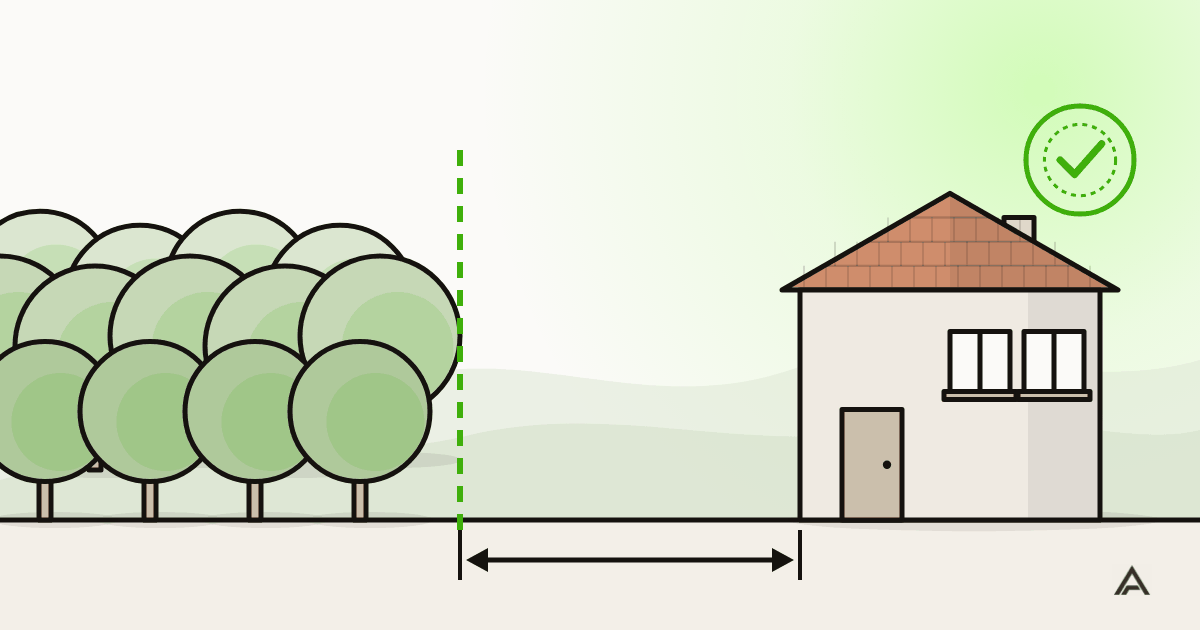
On land in the national forest fund you will not get a building permit: the Urbanism Code forbids building in forest zones. A house becomes possible only by the route in the Forest Code (Legea 331/2024): the land must be privately owned forest, outside the counties short of forest, and it must be taken out of the forest fund for good, on no more than 500 sq m, with land given in exchange at least three times larger. If your plot is next to a forest rather than in it, within 50 m of the forest edge, the permit needs the approval (aviz) of the Garda Forestieră.
The rules in one table
| Situation | What applies | Source |
|---|---|---|
| Land in the forest fund, with no other steps | Building is forbidden | Legea 169/2026, art. 172 para. (2) |
| A house or holiday home on private forest | Allowed only after the land is taken out of the fund for good, with compensation | Legea 331/2024, art. 41 para. (1) letter c) |
| The same case, in a county whose forest fund covers under 30% of its area | Not allowed | Legea 331/2024, art. 41 para. (1) letter c), annex 1 |
| Maximum area taken out, with access and fence | 500 sq m (property over 5 ha); 1%, at most 300 sq m (under 5 ha) | Legea 331/2024, art. 41 para. (2) letter b) |
| The land given in compensation | At least 3 times the area and 5 times the value | Legea 331/2024, art. 41 para. (3) |
| Building outside the fund, under 50 m from the forest edge | Aviz from the Garda Forestieră | Legea 331/2024, art. 41 para. (12) |
| Protection zone of mountain forests | No building at all, except electronic communications networks | Legea 169/2026, art. 201 para. (2) |
Is your land in the forest fund?
The Forest Code does not define the forest fund by what the land looks like today. The national forest fund covers the land included in the forest management plans (amenajamente silvice) in force on 1 January 1990, with the lawful changes since (article 1 paragraph (2)), plus land with other uses that was in those plans and has not been taken out (paragraph (4)). It holds not only forests but also land to be afforested, tree nurseries, forest roads, forestry cabins and their yards (paragraph (3)).
The other way round, a small wood grown on farmland is not necessarily part of the fund. The Forest Code calls such land cu folosință agrosilvică (agroforestry use) or cu vegetație forestieră din afara FFN (forest vegetation outside the fund) (articles 3 and 4), and the rules on taking land out of the fund do not apply to it.
The ocol silvic, the forest district that manages the area or provides forestry services there, can tell you whether the land is in a management plan. Ask for the answer in writing before you buy.
What the Urbanism Code says
Article 172 has three paragraphs. Forest zones are the zones included in the national forest fund under the Forest Code (paragraph (1)). Permitting buildings in these zones is forbidden (paragraph (2)). The exception (paragraph (3)) refers to the conditions in the Forest Code and in Legea 255/2010 on expropriation for public purposes, for projects of national, county and local interest.
Our reading: the exception reads as if written for public investment, and a house can be permitted only on land that has left the forest zone. The forest zone is defined by membership of the forest fund, and land taken out of the fund for good acquires the use approved with the removal (Forest Code, article 42 paragraph (1)). Only then do you enter the usual procedure: certificat de urbanism, avize, permit, within the limits on building in the extravilan (Legea 169/2026, article 152 paragraph (3)).
There is one more limit to know: the Forest Code forbids bringing forests into the built-up area (intravilan) (article 2 paragraph (3)). A forest therefore usually stays in the extravilan, where the PUG places it in the forest zone (Legea 169/2026, article 152 paragraph (2)). The usual route through a PUZ, described in from extravilan to intravilan, therefore does not apply to a forest.
What the extravilan means for a building, in general, we explained in intravilan or extravilan land.
When the Forest Code allows a house
Reducing the area of the forest fund is forbidden, and taking land out for good is allowed only for the projects listed in articles 40 and 41. Any act to the contrary is absolutely void (article 39 paragraphs (1) and (4)).
For a private person, the relevant option is article 41 paragraph (1) letter c): homes or holiday homes, only on land in the fund that is privately owned, except in counties short of forest. The beneficiary of the removal is the owner of the land. Annex 1 to the Forest Code defines a county short of forest as one where the forest fund covers less than 30% of its area.
Article 41 paragraph (2) sets two cumulative conditions:
- the building and the land belong to the same person;
- for land used as forest or meant for afforestation, the area taken out, including the building, the access and the fence, is at most 500 sq m on a forest property over 5 hectares, and under 5 hectares 1% of the property, but no more than 300 sq m.
On a 2-hectare forest, for example, 1% means 200 sq m, which has to hold the house, the access road and the fence.
Other projects on the same list (letter b)) are tourism and leisure ones, including tourist accommodation such as guesthouses. In the extravilan, removal for them is approved only on the basis of the aviz of the county chief architect.
What you give in exchange
Taking land out for good for a house is done with compensation. The land offered in exchange must be at least 3 times the area of the land removed and worth 5 times as much (article 41 paragraph (3)). It must lie outside the forest fund, adjoining it and fit for afforestation; degraded land, land unproductive for forestry and land in the steppe, alpine and subalpine zones are not accepted (paragraph (8)). After the exchange, your compensation land becomes part of the forest fund (paragraph (9)).
For areas under 50 sq m you may give no land, but you pay in advance 5 times the value of the land removed (paragraph (5)).
Besides the land, article 45 paragraph (1) lists the financial obligations: the tax for taking land out for good, paid before approval, the lost growth of trees felled before harvesting age, and the cost of afforestation and upkeep until the stand closes. The Forest Code gives no fixed amount for the tax; it is calculated from the tariffs in the land fund law, Legea 18/1991 (article 41 paragraph (7)). Ask for the calculation in writing before you buy the compensation land.
Who approves it and what follows
The application needs the owner’s consent and the favourable aviz of the ocol silvic. It is approved by the head of the competent Garda Forestieră for areas up to 1 hectare, so for any house within the limits above (article 44 paragraph (1)).
After approval, you pay the obligations and sign the handover record with the ocol silvic, in the presence of the Garda Forestieră, within 180 days at most. If you do not take over the land within that time, the approval is revoked or annulled (article 45 paragraphs (3) and (4)).
The chosen use binds you. The building cannot change its use earlier than 5 years after final acceptance; otherwise the Garda Forestieră seeks annulment of the approval and the return of the land to its original state, at your cost (article 42 paragraph (3)).
Next to a forest: the 50-metre rule
Article 41 paragraph (12) concerns land outside the forest fund: buildings less than 50 metres from the forest edge are permitted with the aviz of the competent Garda Forestieră. The only exceptions are projects of national, county or local interest.
This rule reaches far more owners than removal from the fund does: any house, inside or outside the built-up area, on a plot that ends at the edge of a forest. The Forest Code does not define the forest edge. Our reading: the distance is measured from the edge of the neighbouring forest fund, so ask the ocol silvic where that boundary runs before the design starts.
Like any aviz the law requires, the Garda Forestieră’s aviz should appear in the certificat de urbanism; if it is missing and the plot is next to a forest, ask the primărie. How avize and their deadlines work is on the page about avize for the building permit.
In the mountains
In the mountain zone, the Urbanism Code adds a ban of its own. The protection zone of forest ecosystems and mountain forests is drawn through spatial planning and urbanism documents, and inside it any building is forbidden, except electronic communications networks (article 201 paragraphs (1) and (2) and article 326 paragraph (3) letter c)). The mountain zone is the one defined by the mountain law, Legea 197/2018 (article 201 paragraph (3)).
Also in the mountains, settlements may grow only as a continuation of existing ones and may not go above the upper limit of the forest zones (article 203 paragraph (1)). If the PUG or the county plan has drawn the mountain-forest protection zone over your land, taking it out of the forest fund no longer opens the way to a house.
From the ocol silvic to the permit
- Find out from the ocol silvic whether the land is in the forest fund and how large your forest property is.
- Check whether the forest fund covers under 30% of the county; if it does, a house cannot be built on that land.
- Ask for an informative certificat de urbanism to see what the PUG provides, including mountain protection zones.
- If the way is open, look for the compensation land and ask for the calculation of the obligations.
- File the application for removal, with the aviz of the ocol silvic, at the Garda Forestieră.
- After the land is handed over, start the certificat de urbanism procedure for building.
This article is analysis, not legal advice. The provisions cited are from Legea 169/2026, published in Monitorul Oficial no. 661 of 10 August 2026 (with the rectification in Monitorul Oficial no. 862 of 14 October 2026), and from Legea 331/2024 on the Forest Code, published in Monitorul Oficial no. 7 of 9 January 2025, in its form consolidated on 8 August 2026 (the articles cited are unamended). The boundaries of the forest fund and of protection zones differ from one plot to another. Romanian legal terms are kept in the original where the English would be misleading. Check your own situation with the issuing authority.