
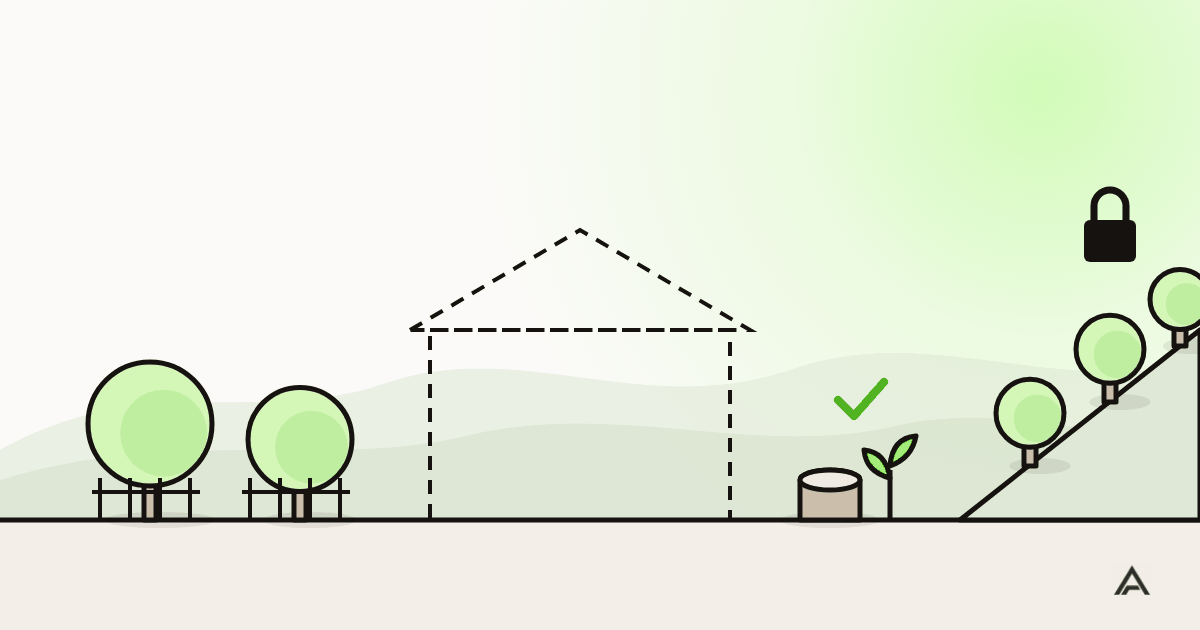
For a tree in the garden of your house, Legea 24/2007, the green-spaces law, provides no felling permit. It lists green spaces by type (parks, squares, planted strips, protective corridors and others), and the yard of a home is not on the list. A rule may still come from the local council, and if you clear trees to build, the Urbanism Code requires the felling to rest on a dendrological study, and the felling authorisation goes into the building permit file if the certificat de urbanism asks for it.
In short
| Situation | What applies | Source |
|---|---|---|
| A tree in your garden, no building works | Legea 24/2007 provides no permit; check local rules and whether the tree is protected | Legea 24/2007, art. 3, art. 8(2) |
| A tree moved (transplanted) from a green space | Consent of the primărie and the environmental authority | Legea 24/2007, art. 9(2) |
| Healthy trees cut by the primărie on urban green spaces | An aviz from the county environmental protection agency | Legea 24/2007, art. 12(6) |
| Trees removed for a building | A dendrological study for clearing; the felling authorisation if the certificat de urbanism asks for it | Legea 169/2026, art. 393(3), art. 265(2)(i) |
| Plantings that affect the stability of the ground | Removing them is banned in all cases | Legea 169/2026, art. 393(4) |
| A garden laid out under a site-works permit | Dendrological study, felling authorisation (if trees are removed), planting and felling plans | Legea 169/2026, art. 289(2)(c) and (e), annex 4 point 7(e) |
What Legea 24/2007 says
Legea 24/2007 applies to green spaces inside the built-up area (intravilan), that is to land of the types listed in article 3: public green spaces with unrestricted access (parks, gardens, squares, planted strips), public green spaces for specialised use (botanical gardens, the grounds of schools, hospitals, cemeteries), leisure grounds, spaces protecting water, protective corridors along infrastructure, leisure forests, nurseries and greenhouses. A garden, in the law’s sense, is one open to the public (article 4(c)).
For these spaces the law has four rules on trees:
- nobody may make unauthorised cuts or harm trees and shrubs on green spaces (article 5(c));
- trees and shrubs may be transplanted only with the consent of the local administration and the territorial environmental authorities (article 9(2));
- for ornamental trees on public-domain green spaces and in street alignments, cutting into the crown is banned, except for dead branches and those that endanger pedestrians, traffic, nearby buildings or overhead networks (article 12(5));
- a primărie’s decisions to cut healthy trees on urban green spaces take effect only after an aviz from the county environmental protection agency (article 12(6)).
Green spaces on private land exist in the law too: their owners administer them, in line with the legislation in force (article 8(2)), and the owners maintain them and take measures for the safety of people who could be hit by broken branches or ageing trees (article 12(1)-(3)).
Your garden: what Legea 24/2007 does not cover
We read Legea 24/2007 in its 2014 consolidated form, in full. It contains no permit procedure for cutting a tree in the garden of a home, and it does not put a house garden among the green-space types in article 3. Our reading: if your land is not one of those types and is not registered as a green space, Legea 24/2007 does not require a permit for you to cut a tree in your garden. The law even supports this reading: private land entered in the land register as curți-construcții (yards and building land) cannot be inventoried or declared green space except after expropriation (article 18(9)).
That does not mean you can cut without asking anyone. Primării are required to keep a local register of green spaces (article 16), and the area of a green space in the law’s sense cannot be reduced (article 18(5)). Before cutting, ask the primărie in writing whether your land is in the register, whether the tree or the area is protected, and whether the local council has adopted rules of its own, for example an aviz for trees on private land. A written answer is useful if someone files a complaint.
Legea 24/2007 covers only the built-up area (article 1). For a forest, land in the national forest fund or land outside the built-up area, the rules are different and we do not cover them here. Nor have we reviewed the national rules on protected trees (monumental trees, natural monuments) and protected natural areas: the Code itself mentions monumental trees (article 289(2)(c)). For such a tree, do not rely on this text: ask the environmental authority.
When you clear trees to build: what the Code requires
The trees on your plot come up at four points in the permit process: three in the Urbanism Code (Legea 169/2026) and one in the forms of Order 975/2026.
The first is the topographic survey, which must show trees with their relevant levels (article 265(2)(d)). What else that survey must contain is in the topographic survey: three conditions.
The second is the supporting documents. Among them, for removing material dendrologic (trees and shrubs), the Code lists the related authorisation, issued under the special law (article 265(2)(i)). But the supporting documents are the ones requested through the certificat de urbanism (paragraph (1)), so the certificat de urbanism tells you whether you must bring it. The Code does not name the special law and does not define material dendrologic.
The third is the application itself. The technical annex to the building permit application (form F_A_01 in Order 975/2026, point 6) has a field for the number of trees cut, kept and planted. How to fill in that annex is in the technical annex and the area table.
The fourth is the site. Article 393 has four paragraphs:
- building works respect the rules on plantings and clearing in environmental legislation;
- the site organisation project provides measures to protect the trees and shrubs that stay;
- clearing is done only on the basis of a dendrological study, which shows what vegetation must be kept and what may be cut on condition of replanting;
- removing plantings that affect the stability of the ground is banned in all cases; they may be cleared only to regenerate ageing or degraded vegetation.
The technical report for site organisation also covers the measures to protect existing vegetation and, where relevant, a clearing and replanting plan (article 291(5)(g) and (h)). How site organisation is authorised is in site organisation: what gets authorised.
The dendrological study does not depend on the certificat de urbanism: article 393(3) requires it for any clearing done in building works. The certificat de urbanism may ask you, as a supporting document, for the felling authorisation (article 265(2)(i)). The Code does not say from how many trees clearing begins. Our reading: if the project removes trees, commission the dendrological study anyway and ask for the certificat de urbanism to say clearly whether you also need the felling authorisation.
On a sloping plot
Article 393(4) is the strictest rule in this chain: removing plantings that affect the stability of the ground is banned in all cases, and clearing them is allowed only to regenerate ageing or degraded vegetation. The text mentions neither slopes nor the geotechnical study. Our reading: on a sloping plot, the trees that hold the soil fall under it, so you cannot remove them to make room for the house, not even with a dendrological study, and if the geotechnical study shows unstable ground, the project should keep the plantings that hold it.
A garden laid out under a site-works permit
Among the supporting documents for a site-works permit, the Code lists a dendrological study for green or planted spaces, identifying any monumental trees, and the authorisation for removing trees and shrubs (article 289(2)(c) and (e)). The project for authorising site works includes, for green spaces or any intervention on trees, planting and felling plans (annex 4, point 7(e)).
When you need that kind of permit is on the page about the site-works permit.
What to do, in order
- Check whether your land is in the local green-space register, whether the tree or the area is protected, and whether the primărie has rules on trees. Ask for the answer in writing.
- If you only want to cut a tree in your garden, with no works, and the primărie confirms the tree is not protected and there is no local rule, keep the primărie’s answer and photos of the tree before cutting.
- If you plan to build, ask the surveyor to put the trees in the survey and agree with your designer which ones stay. How much green space the zone’s rules require is in green spaces in the permit.
- If the project removes trees, commission the dendrological study, and if the certificat de urbanism asks for the felling authorisation, add it to the file.
- On site, the trees that stay are protected under the site organisation project, and those cut are replanted if the study requires it.
This article is analysis, not legal advice. The provisions cited are from Legea 169/2026, published in Monitorul Oficial no. 661 of 10 August 2026 (with the rectification in Monitorul Oficial no. 862 of 14 October 2026), from Legea 24/2007 on the regulation and administration of green spaces in built-up areas, republished in Monitorul Oficial no. 764 of 10 November 2009, in its form consolidated on 19 October 2014, and from Order 975/2026, published in Monitorul Oficial no. 711 of 26 August 2026, with its annexes in Monitorul Oficial no. 711 bis (form F_A_01). Local council rules differ from one place to another. Romanian legal terms are kept in the original where the English would be misleading. Check your own situation with the issuing authority.