
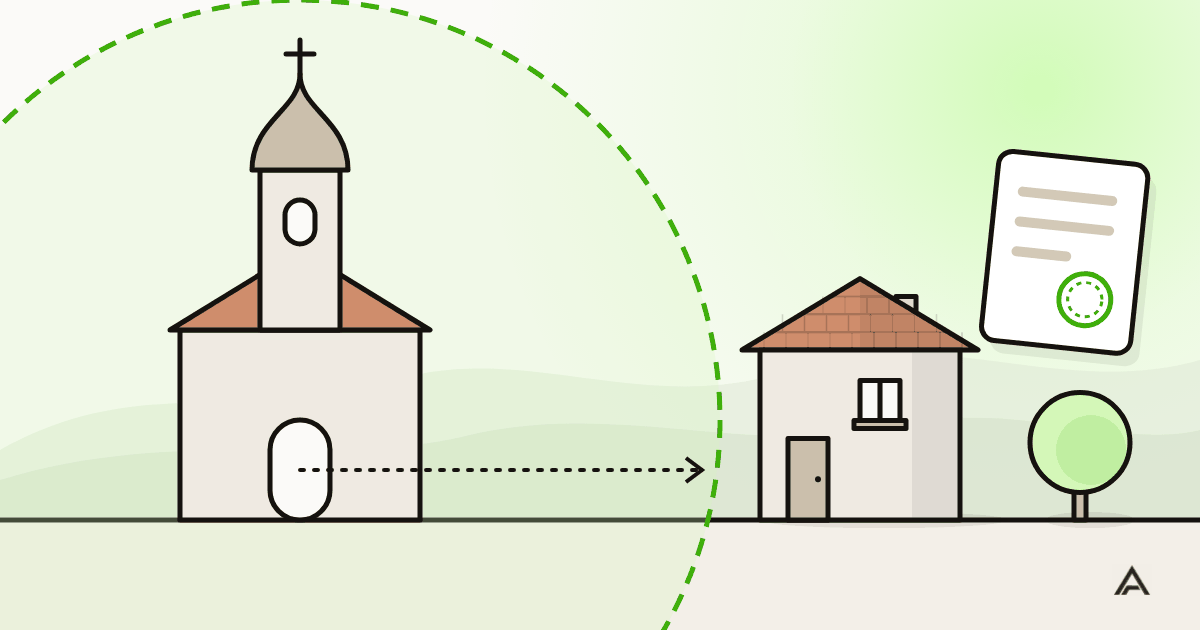
The planning certificate says, under legal status, that the land lies in the protection zone of a historic monument. Your house is not a monument and there is nothing old about it, and the church or manor house in question may be two streets away. The natural question is what it has to do with your project. The answer lies in two laws: Law 422/2001 on the protection of historic monuments and the Urbanism Code (Legea 169/2026).
How big the zone is
Every historic monument gets its own protection zone, drawn from topographic, geographic or urban landmarks, the street pattern, the terrain and the monument’s features (Law 422/2001, article 9 paragraph (1)). The zone is written into the urban plans and their regulations (paragraph (3)), and servitudes and special building rules can be set in it through approved planning documents (paragraph (4)).
For many monuments the zone has not yet been drawn. For those, article 59 of the same law gives a default radius, measured from the outer edge, all around the monument:
| Where the monument is | Radius of the protection zone |
|---|---|
| Urban locality | 100 m |
| Rural locality | 200 m |
| Outside localities | 500 m |
The radius explains why plots with no historic building in sight still get the mention. If the zone has been instituted under article 9 (usually carried into the PUG or a PUZ), the drawing counts, not the circle. Where to find approved plans we covered in the national urbanism geoportal.
The culture opinion, even if you never touch the monument
Article 24 paragraph (1) of Law 422/2001 says that works on properties that are not monuments but sit in a protection zone are authorised on the basis of the opinion (aviz) of the Ministry of Culture or its local services, that is the county culture directorate, alongside the other opinions.
The Urbanism Code says the same from the permitting side. Article 274 paragraph (1) requires the mandatory opinion of the Ministry of Culture or its local services for buildings placed in monument protection zones, and paragraph (5) extends it to works on existing buildings, to landscaping works and to demolitions.
A new house needs an extra study
Paragraph (2) of article 274 is the one that changes the design budget. For a new building in the protection zone, the opinion is issued on the basis of a specific study showing the new building’s impact on the cultural resource nearby and its visual effect on the monuments that may be affected, including lines of sight.
The opinion is not a formality. Under paragraph (3), the Ministry or its services may refuse it or make it conditional on changing the design and redoing the PAC, if the size, architecture, exterior or position of the new building would alter the character of the area, the landscape, the cultural resource, valuable views or the legitimate interests of the neighbourhood. So the architect should know about the zone before the first sketch, not after the PAC is done. What the PAC contains is on the PAC page.
How long the opinion takes
The Code sets, in article 269 paragraph (9), a general 15-day deadline for opinions issued outside the single-approval committee, with exceptions. For monument protection authorities, the deadline is at most 30 days from the date the documents are examined by the national or zonal historic monuments committee or, where relevant, the National Archaeology Committee (point (ii)). Article 316 paragraph (3), however, gives the same opinion a different deadline: at most 30 working days from receipt of the complete specific documentation, for buildings. The Code does not say which of the two prevails, so plan around both dates: the day you file the complete documentation and the date of the committee meeting. How the opinions fit together in time we covered in the order of steps by deadline.
What is no longer free in the zone
A protection zone closes a few short routes that an ordinary plot has:
- Works with no formality at all. Article 299 paragraph (2) letter a) allows certain works on existing buildings without a permit and without notification, but only outside protected built-up areas and monument protection zones.
- Notification for small new structures. Article 294 paragraph (2) letters a) and b) allow small new structures (garages, covered terraces, summer kitchens), and also new fences, roof replacement or a loft conversion, on notification only outside protected areas and monument protection zones. Who qualifies otherwise is in do you qualify for notification.
- Small repairs have their own route. For buildings in the zone that are not monuments, are not being classified and have no architectural or historic value set by planning documents, article 294 paragraph (3) allows a list of works (among them repairs to finishes keeping the material and colour, windows and doors keeping their material, shape and size, interior repairs, floors, interior services, stoves, repairs to fences and roofs without changing shape and materials, light partitions) on prior notification to the town hall and the local culture service, with that service’s written consent, which sets the conditions and deadlines for the works. Article 284 paragraph (3) says these works need no building permit, but the notification and consent in article 294 paragraph (3) still apply.
The difference from an ordinary plot is clearest on the roof: outside the zone, repairing it without changing its shape and appearance requires nothing; in the zone, for a house with no value set by planning documents, you need the culture directorate’s written consent.
Money: a narrow reduction
The fee exemption for works on monuments themselves is explained on the permit fees page. For the monument’s neighbours, Law 422/2001 has a narrower reduction: owners of properties in the protection zone get a 50% reduction of permit fees for works they fund that are needed to preserve the monument’s physical integrity and its built or natural setting, as regulated by the zone’s planning documents or by the culture directorate’s opinion (article 44). An ordinary new house is not covered.
What you risk by skipping the opinion
Law 422/2001 makes carrying out works in the protection zone without the opinion of the Ministry of Culture or its services a minor offence (article 55 paragraph (1) letter a)), with a fine of 5,000 to 10,000 lei (paragraph (2)). The authority faces the same fine if it fails to state the need for the opinion in the planning certificate or issues the permit without it (letters e) and f)). If your certificate does not mention the zone but it exists, ask directly, because a missing opinion comes to light later, not sooner.
Article 55 applies only where the act is not a criminal offence. Building without a permit, or in breach of it, in a monument’s protection zone is a criminal offence under article 356 paragraph (1) letter a) of the Urbanism Code (3 months to 1 year in prison or a fine); see where criminal liability begins. The full list of opinions a plot’s status triggers is in what permits a protected area requires.
In short, before the design
- Read the legal status in the planning certificate and look the monument up in the List of Historic Monuments.
- Check whether the zone has been instituted (usually shown in the PUG or a PUZ); if not, apply the radius in article 59.
- Tell the architect from the start, so the impact study is part of the design.
- Put both the date you file the complete documentation and the monuments committee meeting in the plan.
This article is analysis, not legal advice. The provisions cited are from Law 422/2001 on the protection of historic monuments (republished) and from Legea 169/2026, published in Monitorul Oficial no. 661 of 10 August 2026. Romanian legal terms are kept in the original where there is no exact English equivalent. Check your own situation with the issuing authority.