
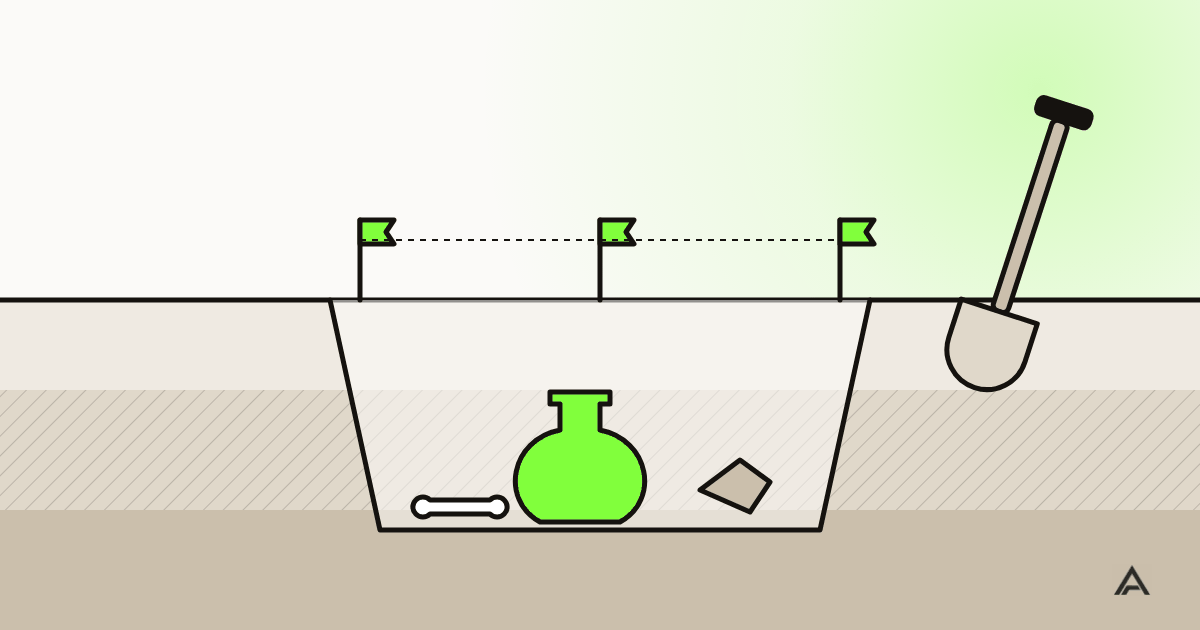
The excavator bucket brings up potsherds, bones or a piece of wall that appears on no plan. On a house site, the temptation is to carry on and say nothing, so the job does not get blocked. The Urban Planning Code requires exactly the opposite, and it does so in terms that partly protect whoever stops.
What has to be done
Article 423 paragraph (6) lists the developer’s obligations during execution, and letter c) is the one that applies here. If archaeological remains (vestigii arheologice) are discovered, execution of the works is suspended, in all execution contracts, public or private. Guarding and protection measures are taken. Two institutions are notified immediately: the issuer of the permit and the county culture directorate (direcția județeană pentru cultură), or the one for the municipality of Bucharest.
The obligation is placed on the developer (dezvoltator). Article 422 paragraph (1) defines the developer as the natural or legal person who finances and carries out construction works, for new buildings or interventions on existing ones. Paragraph (2) adds that any beneficiary may take on the capacity of developer, assuming in full the project-management obligations that fall to the developer. Our reading is that if you finance and carry out your own house yourself, the definition covers you, but the text does not say so separately for people building for themselves.
Contract deadlines move, without penalties
The second half of the same letter is the part that matters for money. The execution and completion deadlines in all works contracts, public and private, shift by operation of law, by effect of the code, by the period in days needed for the archaeological research carried out by the organising institutions, under the specific legislation. The shift happens without penalties or financial corrections.
For a contract with a builder, this means the days needed for the research are added to the deadlines and do not trigger penalties under the contract. How many days that is is not set by the code, but by the institutions doing the research, under their own legislation.
The permit, in zones with archaeological heritage
Article 190 paragraph (3) concerns zones with archaeological heritage revealed by chance and those with archaeological heritage undergoing classification. There, the authorisation of building works is suspended by operation of law until the land has been archaeologically discharged (descărcare de sarcină arheologică), and the mayor may order any other activity to be interrupted.
Zones with archaeological heritage are defined in article 186 paragraph (2) letter c): those with archaeological heritage that is identified, revealed by chance or of priority archaeological interest, defined and delimited under special laws. How a find on your land becomes such a zone, and how archaeological discharge is carried out, are governed by heritage legislation, not by the Urban Planning Code, and we do not describe them here.
Before the site opens, where the heritage is already known
Article 190 paragraph (2) requires that, in zones with archaeological heritage, building or demolition works be authorised only on the basis of, and in accordance with, the prior aviz of the Ministry of Culture or its deconcentrated services. Failing to comply with that aviz is a contravention, with a fine of 50,000 to 500,000 lei, unless the act constitutes a criminal offence, under article 241 paragraph (3).
What changes if the land is in a protected zone, and which other avize join the list, is explained in what approvals a protected zone needs. How the avize required by the certificat de urbanism are obtained in general is on the page about the approvals for a building permit.
The order, if it happens
- Stop the works, under every contract, and secure the spot.
- Notify the permit issuer and the county culture directorate immediately.
- Write down the date works stopped and the date they resumed.
The third point is our advice, not a requirement of the text. The shift is by the days needed for the research, and without written dates that duration is hard to prove to the builder. The other obligations you have before the first day on site are collected in five things before the first day on site. And if the works are stopped by an inspection body rather than by you, the route is the one in your site has been stopped, what follows.
This article is analysis, not legal advice. Provisions are cited from Legea 169/2026, published in Monitorul Oficial no. 661 of 10 August 2026. Check your own situation with the issuing authority. Romanian legal terms are kept in the original, because the Romanian text is the one that governs.