
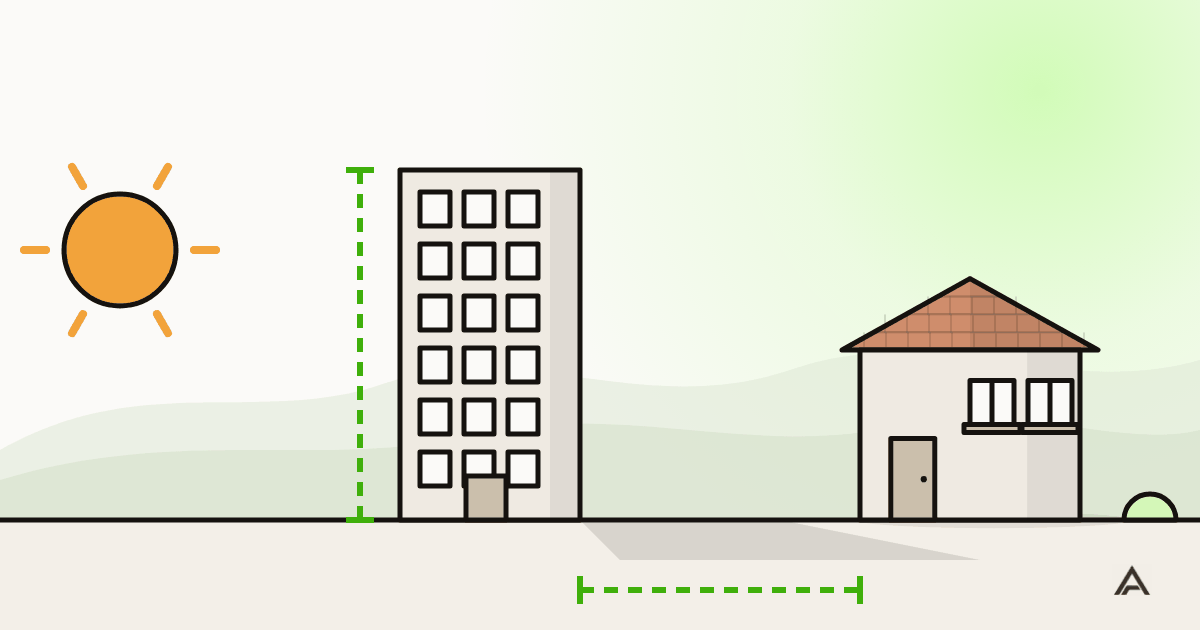
A sunlight study (studiu de însorire) proves one thing: that a new residential building leaves sun in the habitable rooms, its own and its neighbours’, for at least an hour and a half on the shortest day of the year. The rule is in the hygiene norms approved by Order no. 119/2014 of the Minister of Health, article 3, and the study becomes mandatory through a simple distance test. The Urban Planning Code takes the rule up for blocks of flats, in the permit file. For houses the rule is the same, except that nobody issues an opinion on it any more.
The rule, in three paragraphs
| What it says | Where it is written |
|---|---|
| Residential buildings must be sited so that habitable rooms, in the building and in neighbouring homes, get at least 1 1/2 hours of sun at the winter solstice | the Norms, art. 3(1) |
| Where the distance between neighbouring buildings is less than or equal to the height of the taller one, a sunlight study is drawn up | art. 3(2) |
| Next to a blind wall, the rule applies only to walls with windows, respecting the right to sunlight of the habitable rooms of the oldest building | art. 3(3) |
The winter solstice falls on 21 or 22 December: the day the sun climbs least in the sky and shadows are longest.
Which rooms count
The Norms require sunlight for încăperilor de locuit (habitable rooms), and article 1(a) defines them: încăperile cu funcții de cameră de zi și dormitoare (rooms used as living rooms and bedrooms). The kitchen, bathroom, hallway and stairs are left out. A design can therefore leave a kitchen without winter sun and comply, but not a bedroom.
The study also checks the rooms around it: once the new building is up, every habitable room of the neighbours must still get its hour and a half.
When the study becomes mandatory
The test in paragraph (2) compares two figures: the distance between neighbouring buildings and the height of the taller one. If the distance is less than or equal to that height, the study is mandatory. A 15 m block 12 m from a house needs one; a 7 m house 10 m from a lower one does not.
The Norms do not say which height to use. Annex 1 of Legea 169/2026 defines two: total height, measured to the highest element, on a pitched roof the ridge, and façade height, measured to the eaves or cornice, both from natural ground level before any works. Our reading: for a test that decides whether a study is needed, the cautious choice is total height. The difference matters for houses with tall roofs, where the ridge sits several metres above the eaves.
The test is between buildings, not to the fence. Distances from the property line are a separate rule, explained in how close to your neighbour you can build.
Blind walls and who was there first
Paragraph (3) settles two common situations in towns. If the neighbour’s wall facing you is a calcan, a wall with no windows, there are no room windows on that side to be shaded, so the rule applies only to walls with windows.
The second half of the paragraph protects dreptul la însorire a încăperilor de locuit ale celui mai vechi amplasament (the right to sunlight of the habitable rooms of the oldest building). Our reading: when a new block goes up next to an old house, the old house has priority, and the new design has to leave it its hour and a half, not the other way round.
Who asks for a sunlight study, for flats and for houses
For blocks of flats, the Urban Planning Code puts the rule in the file. Article 265(2)(j) lists among the supplementary documents, requested through the urban planning certificate, documentation on hygiene and public health norms, with the technical report checked for the basic requirement of hygiene, health and environment. Paragraph (3)(a) says what it covers for the site: sanitary protection zones and distanțele minime între clădiri care să asigure însorirea și iluminarea naturală normată (minimum distances between buildings that ensure the standard sunlight and natural light).
For houses, article 267(2)(a) exempts new single-family homes, and any work on existing ones, from the public health opinion, except where the law expressly requires a health impact study. That does not suspend the Norms: article 2 of the order says they are binding on all units and pentru întreaga populație (on the whole population). So for a house nobody issues an opinion on sunlight any more. Our reading: if the buildings stand no further apart than the taller one is high, the study still has to be done, and the urban planning certificate may ask for it.
Two other places in the rules bring sunlight in. The Code’s annex 1 definition of a semi-basement says it may contain homes dacă se respectă condițiile normate specifice, inclusiv nivelul minim de însorire și iluminare (if the specific standard conditions are met, including the minimum level of sunlight and light). And article 19(2) of the Norms requires blocks of flats to take into account the orientation of rooms, the winds and însorirea maximă din timpul verii (maximum summer sunlight).
What neither the order nor the Code says
Neither says who draws up the study, which method it uses or what it looks like. Nor does the term studiu de însorire appear in Legea 169/2026: the Code speaks of distances that ensure sunlight, while the study as such is required only by the hygiene Norms.
Which studies the town hall actually asks for on your plot is shown in the urban planning certificate; how to get one and what it contains is on the page about the urban planning certificate.
If the neighbour’s block takes your sun
If a new building leaves your bedrooms with less than an hour and a half of sun, there are two questions to ask: whether its file had a sunlight study, and whether the study took your rooms into account. The first you can find out from the town hall, which has to make the permits it issues public. For the second you need a specialist to check the sunlight in your rooms.
What the town hall publishes is in what the town hall must publish about permits. As a neighbour whose light is taken by a building, you can invoke a private interest, and the routes and deadlines for asking for the permit to be annulled are explained in annulling a building permit: who and by when. That guide also explains from which date the deadlines run; the day you noticed the shadow is not, by itself, the starting point.
This article is analysis, not legal advice. The sunlight rule cited is from the norms approved by Order 119/2014 of the Minister of Health (consolidated form of 5 May 2026). The Code’s provisions are from Legea 169/2026, published in Monitorul Oficial no. 661 of 10 August 2026. Romanian legal terms are kept in the original where the English would be misleading. Check your own situation with the issuing authority.