
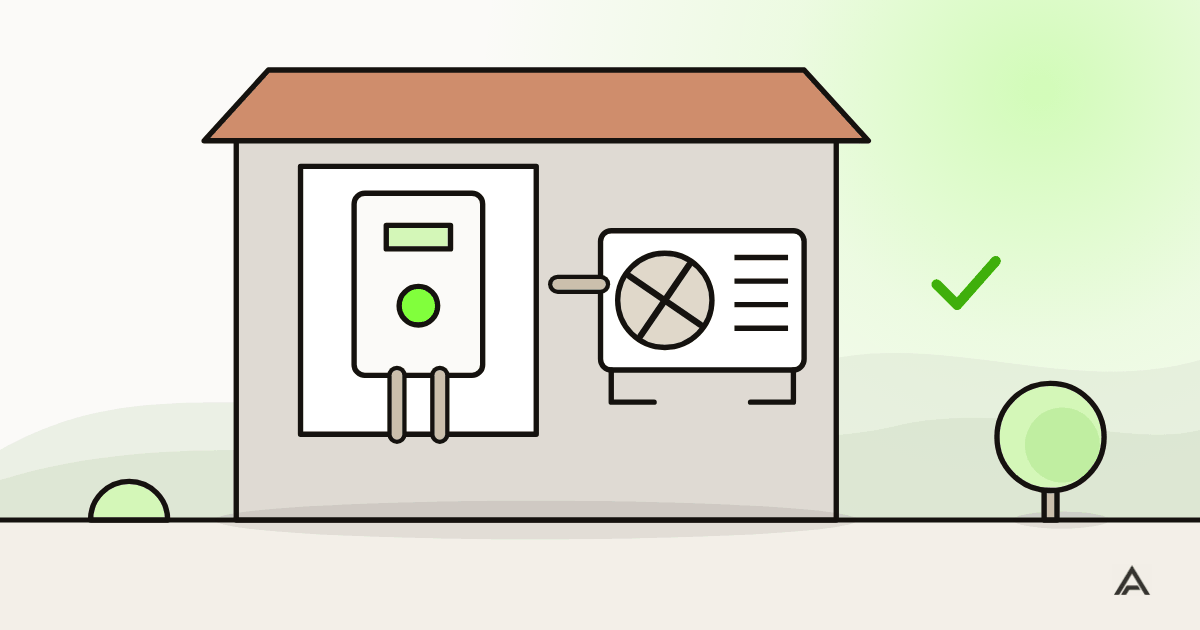
On the flat’s boiler, the air conditioning unit or the water heater, the Urbanism Code (Legea 169/2026) has a single sentence that exempts them expressly. It answers the permit question and leaves nearly every other one open: who fits it, who inspects it, what the owners’ association says. It is worth reading exactly, because its limit is not the type of appliance but where the building stands.
Point 10, word for word
Article 299(2)(a) lists the works that can be done “without any formality”, meaning with no building permit and no notification. Point 10 reads: “fitting local heating and domestic hot water systems, and fitting individual air conditioning units and/or utility consumption meters” (montarea sistemelor locale de încălzire și de preparare a apei calde menajere, precum și montarea aparatelor individuale de climatizare și/sau de contorizare a consumurilor de utilități).
On the text, this covers:
- a home’s boiler (centrală termică), as a local heating system;
- a water heater or other domestic hot water appliance;
- an individual air conditioning unit;
- utility meters and heat cost allocators.
Stoves have their own point: repairing and replacing heating stoves and their chimneys also needs no formality (point 8).
Heat pumps are not named. The Code does not use the term anywhere. A heat pump that heats a single home reads naturally as a local heating system, and its outdoor unit looks much like an air conditioner’s. That is a reading, not a text; if the installation is large or serves several homes, ask the town hall first.
Where the exemption does not apply
Letter (a) opens with a condition that governs all of its points: the works are exempt only “outside protected built-up areas and protection zones of historic monuments” (în afara zonelor construite protejate și a zonelor de protecție a monumentelor istorice). The historic centres of many towns are such areas.
For buildings in these areas that are neither historic monuments (listed or being listed) nor buildings of architectural or historic value designated by urban planning documents, the Code has separate lists, in art. 284(3) and art. 294(3). For the others, those lists do not apply. Both include repairing or replacing interior installations, and repairing or replacing stoves and chimneys while keeping their shape, size and materials. Neither includes fitting a new heating system or an air conditioning unit. We explained how the two lists work together in the article on a house in a monument’s protection zone: works on the list need no permit, but they do need a notification and the written agreement of the Ministry of Culture’s local office.
Anything on neither list falls back on the general rule: a building permit is mandatory (art. 259(6)), and work on a building’s installations counts as intervention work (art. 259(3)). A new outdoor unit on the facade of a building in a protected area is therefore, as a rule, outside every exemption. The one opening is article 274(6): in a protected built-up zone, though not in a monument protection zone, works without any formality are allowed only where the local urban planning regulation provides for it. The Code does not say how this squares with the condition at the start of the list, so our reading is that you should ask the town hall first. The stakes are not small: carrying out building works without a permit on buildings in protected areas is a criminal offence, not a minor one, punishable by 3 months to a year in prison or a fine (art. 356(1)(a)).
A new plant room
If you want to make room at the house for the boiler or the heat pump, it is no longer just a matter of fitting. Extending rooms of an existing building, or changing their use, to create bathrooms or plant rooms (camere tehnice) of up to 25 sqm can be done by notification (art. 294(2)(b)(x)), again outside protected areas. The notification needs a technical project; the procedure is on the page about simplified notification. Above 25 sqm point (x) no longer applies and the extension needs a building permit; the rules are in extending a house. A plant room built as a separate structure next to the house may fall under a different rule: inside the built-up area of a rural locality outside metropolitan areas, new buildings separate from a single-family house (the law gives garages, summer kitchens, bathrooms and the like as examples) can be built by notification if together they do not exceed 50 sqm and they comply with the approved urban planning documents (art. 294(2)(a)(i)). Protected areas and the protection zones of historic monuments are excluded here too.
In a block of flats, the open questions
Point 10 does not distinguish a house from a flat and says nothing about the shared facade, the owners’ association’s consent or where the outdoor unit goes. Those belong to the rules on common property, not to urbanism, and the permit exemption does not replace them.
The Code also says nothing about disconnecting from district heating (termoficare): the word does not appear in the text. If you have read that disconnecting needs a permit from the town hall, that rule does not come from the Urbanism Code.
Fitting, commissioning and periodic inspection of a gas boiler fall under the gas-sector rules, not the Urbanism Code.
What still applies
Point 10 spares you the trip to the town hall, not your other obligations. Article 299(3)-(5) requires compliance with urban planning and technical regulations, places liability on the owner jointly with the designers and contractors, and makes acceptance at completion mandatory, recorded in the building’s technical book and in the National Register of Buildings. The Code applies expressly to a building’s installations too, among which it names heating, gas and air conditioning installations (art. 366(3)-(4)).
In practice: at the end, sign an acceptance report with the firm under your contract; the invoice does not stand in for it. You will look for both when you sell the home or when something stops working.
| Situation | What the Code asks |
|---|---|
| Boiler, water heater or air conditioning, building outside protected areas | No formality (art. 299(2)(a) point 10) |
| Replacing an interior installation, in a protected area, on a building that is neither a monument nor designated as valuable in urban planning documents | Notification and the written agreement of the Ministry of Culture’s local office (art. 294(3)) |
| New unit on the facade, in a protected area | Building permit, unless the area is a protected built-up zone whose local regulation allows the works without formality (art. 274(6)) |
| Plant room by extending or changing the use of existing rooms, up to 25 sqm | Notification, outside protected areas |
The other works that go without a permit, from fences to windows, are on the page about works without a building permit. For windows and facades, the details are in roof, windows, facade.
This article is analysis, not legal advice. The provisions cited are from Legea 169/2026, published in Monitorul Oficial no. 661 of 10 August 2026. Romanian legal terms are kept in the original where the translation would lose precision. Check your own situation with the issuing authority.