
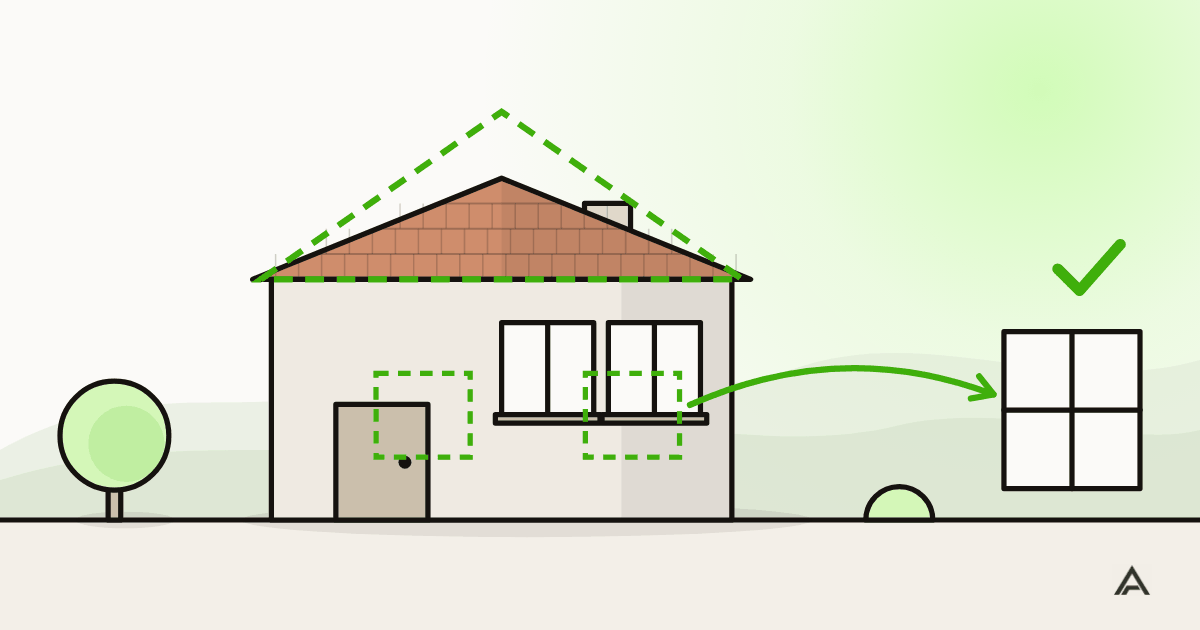
Anyone searching roof replacement permit Romania or window replacement permit still lands on texts built on Legea 50/1991, repealed on 25 August 2026. Today’s answer is in the Urbanism Code (Legea 169/2026), and it has three steps, not two: works that need nothing, works that need a notificare, and works that need a building permit. The roof, the windows and the facade are sorted between them mostly by a criterion that is easy to see in the text: does the shape change or not.
Romanian terms are kept in the original: notificare is the simplified procedure that replaces the permit for a short list of works, and tâmplărie is window and door joinery.
The starting rule
Article 259 para. (3) puts repair, thermal rehabilitation and modernisation among the works of intervention on existing buildings. Paragraph (6) adds that a building permit is mandatory for all works, except those the law lets go through the simplified notificare or with no formality at all. So anything that is not on the two exception lists needs a permit. There is no third bucket of “small works” without a list.
What needs nothing: art. 299
Article 299 para. (2) letter a) lists the interventions on existing buildings that can be done with no permit and no notificare. The four that touch the roof, windows and facade:
| The work | The condition in the text |
|---|---|
| Repairs to roofs, roof coverings or terraces | The shape and appearance do not change (point 2) |
| Repair and replacement of exterior joinery | The shape, the size of the openings and of the joinery stay; the material may differ (point 4) |
| Repairs to plaster, paint, cladding and other exterior finishes | The facade elements and the colours of the building are not altered (point 5) |
| Repairs, replacements or rehabilitation of pavements, access stairs, exterior terraces | No change to the architectural quality and shape of the facade elements (point 6) |
Point 4 answers the question most people ask: timber replaced with PVC, in the same openings and at the same size, needs nothing, because the text says outright that the material can change. If you enlarge a window, move it or cut a new door, the shape of the opening has changed and you are off the list.
All four points share a condition written in the opening of letter a): the house is not in a protected built area and not in the protection zone of a historic monument.
What needs a notificare: art. 294
Article 294 para. (2) letter b) puts three works on notificare that go beyond plain repair:
- replacing the existing roof in the same shape, or by reconfiguring and raising it by at most 0.50 m, only if eaves and ridge stay within the maximum height allowed by the urbanism regulation (point ii);
- facade remodelling, only if it has no load-bearing role (point vi);
- unitary energy rehabilitation of the envelope and/or the roof, if its structural system does not change, meaning a flat roof stays flat and a pitched roof stays pitched, for individual residential buildings with at most 3 floors (point vii).
The wording of the last point matters: it speaks of individual residential buildings. A block of flats does not fit that description.
The notificare is filed before the works, with a simplified technical project, and the town hall has 15 working days to answer, otherwise it is deemed tacitly approved. The steps are on the page about the simplified notificare, and the full list of categories is in Do you qualify for the simplified notificare?. If the work you are planning is really an attic conversion, the rules are in the article on the attic.
The line between repair and replacement
Here the text gives no simple rule. Roof repairs are in art. 299, with no formalities. Replacing the existing roof is in art. 294, on notificare. Annex 1 helps only half way: it defines the roof as an assembly, the covering together with the structure that carries it, and routine repairs as plastering, painting and fixing minor parts. Replacing a cracked tile fits there. Replacing the whole covering does not look like a minor part, and the Code does not put it expressly on either list.
The most cautious reading is that it comes close to replacing the roof under art. 294, so to a notificare, especially if the rafters change too. That is a reading, not a text. Put the question to the town hall before hiring the crew, so you do not learn after the roof is done that you needed a notificare. If the answer is notificare, the fee for the simplified procedure is half the permit fee; you work it out with the fee calculator.
In a protected zone, joinery can no longer change material
The same window in a protected built area or in a monument protection zone follows another route. The lists in art. 299 and in art. 294 para. (2) letter b) open with outside protected built areas, so they do not apply. The one opening is article 274(6): in a protected built-up zone, though not in a monument protection zone, works without any formality are allowed only where the local urban planning regulation provides for it. The Code does not say how this squares with the condition at the start of the list, so our reading is that you should ask the town hall first. Article 294 para. (3) has its own list, for buildings that are not listed monuments: notificare plus the written agreement of the decentralised culture service. The conditions there are tighter:
- repair and replacement of exterior joinery requires keeping the material, the shape and the size of the openings;
- repairs to roofs and roof coverings require that the shape and materials do not change;
- exterior finishes are repaired only by keeping the material, colour and texture.
Timber replaced with PVC, which needs nothing outside the zone, is no longer on the list inside it. More on this regime in a house in a monument protection zone.
No formalities does not mean no rules
Paragraphs (3)-(5) of art. 299 apply to works done with no formality as well. Compliance with urbanism and technical rules is mandatory, liability for breaching them falls on the beneficiary jointly with the designers and contractors, and acceptance at completion is mandatory and is entered in the building’s technical record and in the National Register of Constructions. In practice: ask the crew for a contract and an acceptance record, even if the town hall saw nothing.
Photovoltaic and solar panels on the roof have their own point, art. 299 para. (2) letter a) point 13: see solar panels on a house.
The general list of works that need no permit, with the fence, the garage and demolition, is on the page about works without a building permit.
This article is analysis, not legal advice. The provisions cited are from Legea 169/2026, published in Monitorul Oficial no. 661 of 10 August 2026. Check your own situation with the issuing authority.