
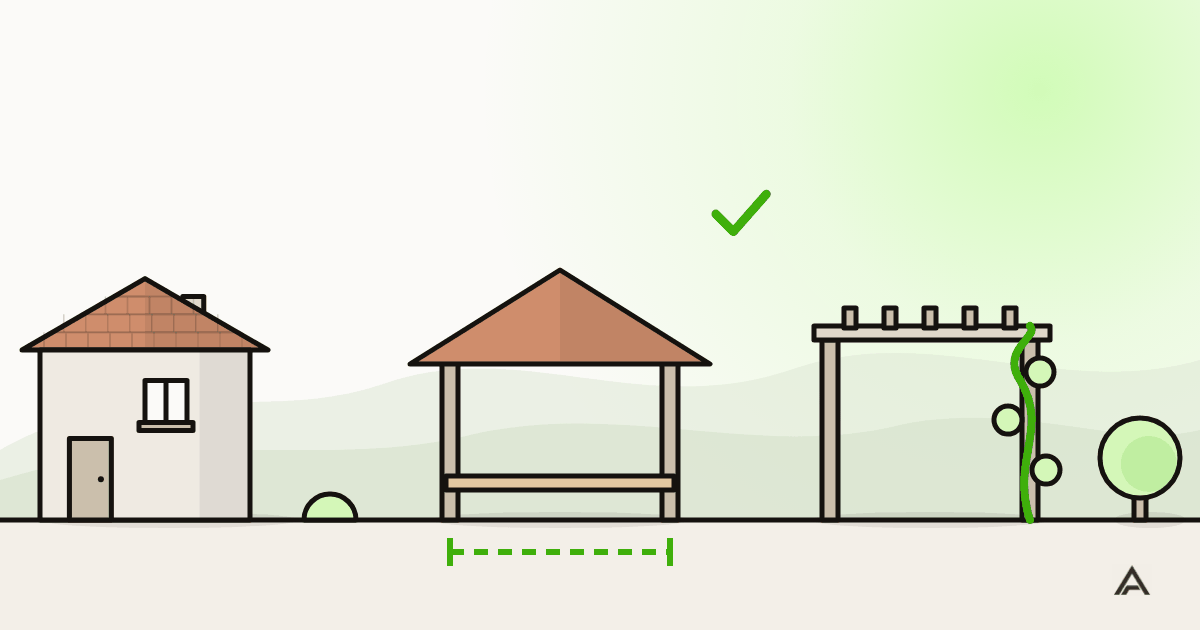
If you are asking whether a gazebo (foișor) needs a permit, the text that matters is Legea 169/2026, and the garden gazebo is not in it. The word appears once, in the annex 1 definition of the loggia, which says a loggia corresponds in old Romanian architecture to the cerdac and the foișor, a sense close to a veranda and not to a pavilion in the yard. The answer depends on the category your structure falls into: pergola, light rural annex, annex on notification, or a construction that needs a permit. What moves it from one to another is mostly the roof and where the plot is.
In short: which regime your gazebo has
| What you have | Regime | Where it says so |
|---|---|---|
| Light wood or metal structure, with climbing plants or light retractable awnings, inside the property, outside protected built-up zones (also in cities) | No permit and no notification | annex 1 (pergola), art. 299 para. (2) lit. b) pt. 4 |
| Gazebo with a fixed roof next to a house, in a village: at most 20 sq m cumulatively with other new annexes, at most 2.5 m high, no foundation, demountable, wood or metal structure | Our reading: no permit and no notification; declared for tax | art. 299 para. (2) lit. c), para. (12) |
| Gazebo with a fixed roof next to a house, in a village, inside the built-up area: at most 50 sq m cumulatively, permanent, non-demountable, with foundation, in a commune outside metropolitan zones, with approved urban planning | Our reading: notification | art. 294 para. (2) lit. a) pt. (i) |
| Gazebo with a fixed roof in a city, or in a village but above 50 sq m, or in a commune of a metropolitan zone above 20 sq m or with a foundation | Our reading: building permit | art. 259 para. (2), (6) |
| Any of the above, in a protected zone | Uncertain at the 20 sq m threshold; prior approval or consent for interventions in protected zones; our reading: permit | art. 190 para. (1) |
| The gazebo was built without papers | Our reading: regularisation can be requested, as an annex of at most 150 sq m; uncertain in a protected zone | art. 301 para. (2) |
First: do you have a pergola or a gazebo
Annex 1 defines the pergola as a light structure in a park, a garden or on a building’s terrace, made of a grid of beams and vertical supports, in wood or metal, on which climbing plants grow or which is covered with light retractable awnings. Pergolas inside the property, outside protected built-up zones, can be built with no formality at all, in cities too (article 299 paragraph (2) letter b) point 4). Annex 1 also says their area does not count in the POT and CUT calculation unless the local regulation provides otherwise.
A gazebo with a fixed tile, sheet-metal or polycarbonate roof does not fit this definition: the cover of a pergola is retractable, not a roof. The Code does not say how many slats or what degree of cover turns a pergola into something else, so our reading is that a fixed roof takes the structure out of the pergola category. The pergola too has a limit written in the text: inside the property. One that sticks out past the plot line is no longer on the list. For a gazebo with a fixed roof, the annex category remains, below.
The gazebo as an annex: the rural thresholds
Letter c) of the same paragraph allows with no formality new annex-type constructions, external to single-family homes, built in rural areas, among them covered terraces, pergolas, summer kitchens and kiosks, and similar ones, up to 20 sq m cumulatively, 2.5 m high, no foundation, of a temporary nature, demountable, on a wood or metal structure. The gazebo is not named, so we place it under similar ones, next to the covered terrace and the kiosk. That is a reading, not a text.
The next threshold is article 294 paragraph (2) letter a) point (i): the same constructions, up to 50 sq m cumulatively, including those under 20 sq m built with a foundation, permanent, non-demountable, in rural areas, with one exception: rural localities in metropolitan zones. The notification adds the built-up area, approved urban planning documents and a plot outside protected zones and monument protection zones. How the areas add up, and why a foundation takes you from 20 sq m to the notification, we explained in the farm outbuilding: maximum area, where the full table and the documents required for a permit are too.
Both thresholds are written for constructions external to single-family homes. On a plot with no house neither applies, and a gazebo at the end of an empty plot needs, on our reading, a permit. If your plot is in a different situation from what you assumed, start with inside or outside the built-up area.
Neither the pergola nor the 20 sq m annex escapes the rules. Paragraph (3) of article 299 keeps the duty to respect urban planning and technical rules, letter c) requires the general urban plan, the local regulation and the Civil Code, and paragraph (12) requires the annex to be declared for tax and, when it is removed, a sworn statement. The distance to the neighbour, more exactly than you will find in garden-building tips, is in how close to the neighbour you can build.
In a city, the same gazebo needs a permit
In a city both annex exceptions disappear, because they require a rural area. A gazebo with a fixed roof is, on our reading, on no urban list, so the general rule applies: a building permit is issued mandatorily for the construction works in paragraph (2), outside those on notification or with no formality (article 259 paragraph (2), paragraph (6)). Whether an open gazebo is a new building for annex 1 is again a reading, but with no category that exempts it, the rule stays. The same rule covers you if you exceed the thresholds. In a commune of a metropolitan zone only the notification route up to 50 sq m falls away: the 20 sq m no-formality threshold requires only a rural area and does not exclude metropolitan zones, so a demountable gazebo without foundation of at most 20 sq m remains possible there. One with a foundation, or a bigger one, has no category left.
The design is done by architects and engineers, and who checks it technically depends on the consequence class, which we covered in the consequence class.
Protected zones
The pergola on the no-formality list is only outside protected built-up zones, and the notification for annexes also excludes monument protection zones. The 20 sq m threshold does not repeat the exclusion, but that does not make it a permission there: article 190 paragraph (1) requires prior approval or consent for interventions in protected zones, and building without a permit in a monument’s protection zone or in a protected built-up zone is a crime (article 356 paragraph (1) letter a)). Our reading is that a gazebo there needs a permit.
The approvals collected in such places are described in what approvals a protected zone requires.
If the gazebo is already built
Article 301 paragraph (2) admits the regularisation permit for annexes of homes and farm outbuildings of at most 150 sq m developed area. Annex 1 defines farm outbuildings as constructions in the yard of a household, complementary to dwelling; our reading is that a garden gazebo fits this definition, so it can be regularised as an annex. The conditions in paragraph (3) are cumulative, paragraph (9) requires technical expert reports on the fundamental requirements, and if they cannot be met, paragraph (5) points to demolition. In a protected zone, access to regularisation is uncertain.
The procedure is on the page about the regularisation permit.
For a construction made without the required permit the fine is between 50,000 and 1,000,000 lei, and without the required notification between 5,000 and 50,000 lei (article 357 paragraph (1) letters a) and b), paragraph (4) letters a) and b)). If the gazebo exceeds the conditions of article 299 paragraph (2) letter c) (20 sq m, 2.5 m, no foundation), it needed a notification or a permit, and the fines above apply. The list of works that go without a permit, with their conditions, is on the page about works without a permit.
What you learn from the council
Two things, in writing, before you order the timber. Is your plot in a rural area, or in a commune of a metropolitan zone, where the 50 sq m route disappears? Are the urban planning documents approved and is the plot outside protected zones? The third thing is yours to decide: a fixed or a retractable roof. In a city it moves you between a structure with no papers and one with a full file. A classification request does not start the notification’s 15-working-day clock (article 295 paragraph (9), article 296 paragraph (1)).
This article is analysis, not legal advice. The provisions cited are from Legea 169/2026, published in Monitorul Oficial no. 661 of 10 August 2026. Check your own situation with the issuing authority.