
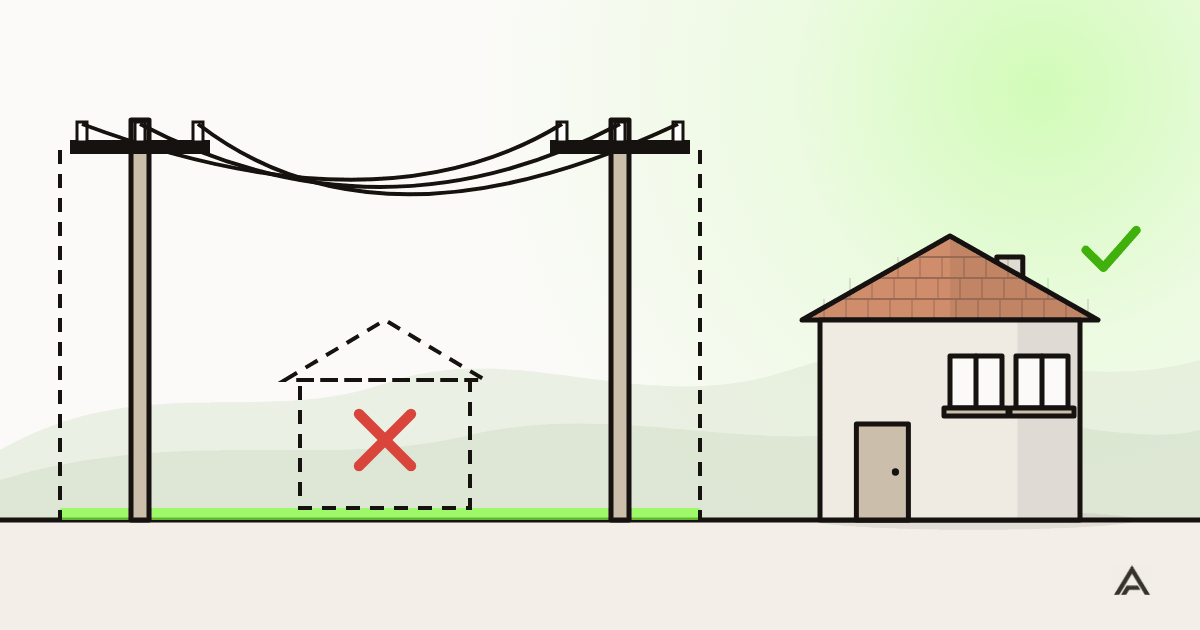
If there are medium-voltage poles next to your house, or on the plot where you want to build, the distance no longer comes from a table of fixed values. Ordinul ANRE 106/2023 removed from the technical norm, with effect from 1 July 2025, the corridor widths of 24, 37 or 55 m that still appear in the top search results. The safety zone is now calculated with a formula, for each span. The norm does not allow a medium-voltage line to cross a house; in our reading, the only route left is a risk analysis accepted by all parties, including the operator.
The rules by type of line
| Line | What the norm says | Source |
|---|---|---|
| Low voltage (up to 1 kV) | The zone runs 1 m beyond the outermost conductors; the horizontal distance between a pole and any part of a building is 1 m | ANRE norm, art. 22(1), annex 5 |
| Above 1 kV, so medium voltage too | The safety zone is calculated with the formula in point 2.3; the minimum safety distance in the formula is 3 m up to 110 kV (4-8 m above) | ANRE norm, annex 6, points 2.3 and 2.4 |
| Fixed widths of 24 m, 37 m, 55 m | Repealed from 1 July 2025 | Ordinul ANRE 106/2023, art. I point 10(d) and art. III(1) |
| A house under the wires of a medium-voltage line | Not allowed without a risk analysis accepted by all parties; crossing over inhabited buildings needs at least 110 kV | ANRE norm, annex 6, point 3.9.1(4); art. 33(2) |
| A pole of 110 kV or more in the yard | Avoided; in unavoidable cases, with the owner’s consent | ANRE norm, annex 6, point 3.9.2(3) |
| A building closer than the safety distance | Only with a risk analysis and the agreement of all parties, paid for by whoever builds | ANRE norm, art. 33(2) and (3) |
Where the rules come from
Distances from power lines are not in the Urbanism Code. They are in the technical norm on the delimitation of protection and safety zones around energy installations, approved by Ordinul ANRE 239/2019 and last amended by Ordinul ANRE 106/2023. The norm also governs the siting approvals (avize de amplasament) that network operators give for buildings near their lines (article 3(b)).
The Urbanism Code makes the link through the certificat de urbanism. The list of approvals for your permit depends on the site and is given to you in the certificate (article 266(1)), and paragraph (2) mentions both the requirements of zones restricted by special regulations (letter d)) and the siting approval for connections (letter e)). How approvals are requested and how long they take, in general, is on the page about approvals for the building permit.
The voltage of the line next to you
The norm treats three cases differently: lines up to 1 kV, that is low voltage (400 V in Romania), lines between 1 kV and 110 kV, which include medium voltage, and lines of 110 kV or more. For an overhead line above 1 kV, the corridor, the protection zone and the safety zone coincide (annex 6, point 2.1^1(2)).
Do not guess the voltage from the height of the pole. The operator must inform the owners of land in the protection and safety zones, and on request other interested parties, about the size of those zones and the restrictions in them (article 26(1) of the norm). Ask for the answer in writing, for your plot.
Low voltage: one metre
For lines up to 1 kV, the protection zone and the safety zone coincide with the line’s corridor and extend 1 m beyond the outermost conductors, horizontally and vertically (article 22(1)).
Annex 5 of the norm adds the rules for buildings. Only a line with insulated twisted conductors may pass over a building, inhabited or not. The horizontal distance between a pole and any part of a building is 1 m. Twisted cable can even be fixed to the façade of buildings with a medium or low fire hazard, at least 10 cm from the wall when strung and 3 cm when laid.
Medium-voltage poles next to your house: the zone is calculated
The width of the safety zone comes from the formula in point 2.3(1) of annex 6. The zone is symmetrical about the line’s axis and adds up the maximum width of the poles, twice the effect of the wind on the insulator string and on the maximum sag of the conductor in that span, plus twice the minimum safety distance. For lines up to 110 kV, that minimum distance is 3 m (point 2.4).
Until 30 June 2025, point 2.5 of annex 6 gave standard widths for the corridor: 24 m for lines between 1 and 36 kV, 37 m for 110 kV, 55 m for 220 kV, 75 m for 400 kV. Ordinul ANRE 106/2023, published in Monitorul Oficial no. 15 of 9 January 2024, repealed points 2.5-2.7 and 2.9 from 1 July 2025.
The formula is used in the operators’ assessments, in coexistence studies and in risk analyses (point 2.3(2)). Our reading: for an existing line, the width that matters on your land is the one the operator calculates for the span between the two nearest poles, and a general figure from the internet does not replace it. Between two distant poles the wires sag more and swing wider than near a pole.
A house under the wires
Point 3.9.1 divides buildings in two. Inhabited buildings include dwellings, industrial buildings and household outbuildings within the used area of the yard. Uninhabited buildings are isolated buildings of secondary importance outside that area that shelter neither people nor animals: garages, barns, sheds, ice houses (paragraph (1)).
A line crosses a building when a conductor, in its normal position or at maximum deviation, is above the building’s footprint; any other proximity is an approach (paragraph (2)). Crossings over buildings by lines above 1,000 V are avoided as far as possible (paragraph (3)). Over inhabited buildings they may be allowed only in unavoidable cases and only if the line is at least 110 kV, the roof covering is non-combustible, class A1, and, if the roof is metal, it is earthed (paragraph (4)).
In the norm’s definitions, high voltage starts above 35 kV and means, in Romania, 110 kV or more. A medium-voltage line does not reach 110 kV, so it does not meet the voltage condition. Our reading: the only route left is the article 33 risk analysis, with the operator’s agreement.
For a shed or a garage outside the used area of the yard, the conditions of paragraph (4) do not apply, because they concern only inhabited buildings. The general rule remains: crossings are avoided as far as possible, and the distances for approaches are in table 13 of the annex, which the operator applies when it issues the approval. The other way round, poles of lines of 110 kV or more are avoided inside the used area of the yard; in unavoidable cases they go there only with the owner’s consent (point 3.9.2(3)).
If you find a general ban on building inside a line’s corridor quoted from point 3.9.2(1), check the date: that paragraph was repealed by Ordinul ANRE 225/2020, published in Monitorul Oficial no. 1237 of 16 December 2020.
Closer: the risk analysis
Article 33(2) of the norm leaves a door open. You may place a building closer than the safety distance, or under conditions other than those regulated, on the basis of a risk analysis and with the agreement of all the parties involved. Annex 6 applies the rule to buildings: if the point 2.3 formula shows that a building would sit inside the safety zone, a risk analysis is required; if it stays outside, no analysis is needed, though a coexistence study may be requested (point 3.1.1(2) and (3)).
The analysis is paid for by the owner of the new building when it affects an existing line (paragraph (3)(a)), so by you, if you want to build next to a line that was already there. It follows ANRE’s methodology for issuing siting approvals (paragraph (3^1)). If you and the operator disagree about the analysis when the approval is issued, ANRE settles the dispute (paragraph (4)).
What rights the operator has on your land
The Electricity and Natural Gas Law (Legea 123/2012) places limits on ownership in favour of the operator: a right of use for works and for running the line, an overhead or underground right of way, and the right to have activities that endanger people and property restricted (article 12(2)). These rights arise from the law and apply without registration in the land book for as long as the line exists (paragraph (3)).
You have rights too. For lines built after the law came into force, in 2012, affected owners can ask for an agreement, which the operator must conclude within 30 days (paragraphs (5), (6) and (8)). Damage caused by works is compensated, and the amount is set by agreement or, if you cannot agree, by a court (paragraph (10)). The operator may also cut vegetation under the line (paragraph (12)); we have written separately about cutting trees as an owner: cutting trees on private property.
A note on the old pole in the yard: article 44(4) says that the land on which distribution networks existing when the law came into force are located is and remains public property of the state, except land the operator has acquired (paragraph (5)). How much land that means around a pole, the law does not say.
Moving the pole: who pays
The law gives no price. The cost of altering distribution installations as a result of connecting new users or changing existing users’ characteristics, including clearing a site, is borne according to ANRE’s regulations (article 44(7)); until those come into force, the law puts it on whoever caused the alteration (paragraph (9)). Ask the operator for its conditions and a written offer before you commission the design.
If you only need power for the house, the connection is a different procedure, explained separately: electricity connection without a building permit.
Four checks on the plot
- Ask the distribution operator, in writing, for the voltage of the line and the size of the zone on your plot.
- Ask for a certificat de urbanism and check whether the list of approvals includes the operator’s siting approval; if the land is in the line’s zone and the approval is missing, ask why.
- Put the line and the poles on the site plan: the topographic survey the Code asks for shows overhead networks and electricity poles (article 265(2)(d)).
- If the project does not fit outside the zone, choose between another position, a risk analysis or moving the line, with the cost of each.
This article is analysis, not legal advice. The provisions cited are from the technical norm on the delimitation of protection and safety zones around energy installations, approved by Ordinul ANRE no. 239/2019 (Monitorul Oficial no. 36 bis of 20 January 2020), as amended up to Ordinul ANRE no. 106/2023, from Legea 123/2012 on electricity and natural gas, in its form consolidated on 26 July 2026, and from Legea 169/2026, published in Monitorul Oficial no. 661 of 10 August 2026 (with the rectification in Monitorul Oficial no. 862 of 14 October 2026). The safety zone of a particular line is set by the network operator. Romanian legal terms are kept in the original where the English would be misleading. Check your own situation with the issuing authority.