
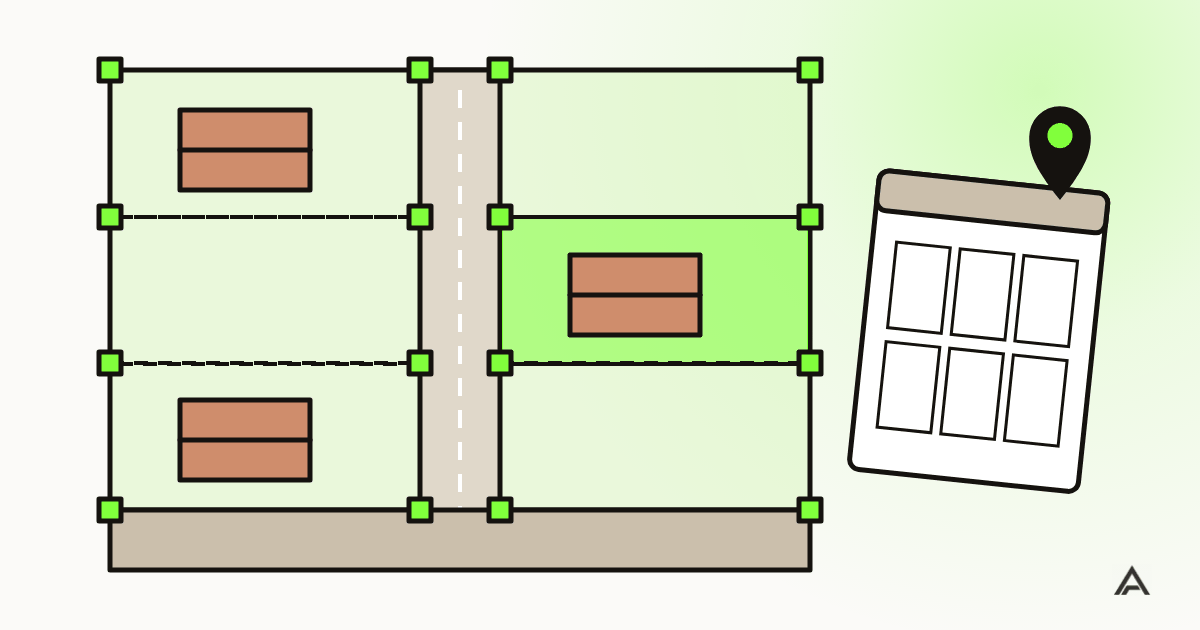
If you split a plot in two, the Urbanism Code calls the operation a dezmembrare and asks only for the certificat de urbanism for operațiuni cadastrale. From three plots upwards, created so that they can be built on, it is a parcelare, an urbanism operation: you need a plan urbanistic zonal (PUZ) or, once and for no more than 12 house plots, a proiect urbanistic de detaliu (PUD), where the area’s PUG or PUZ already sets plot rules. Deeds signed without the required certificat de urbanism can be void, and the fine reaches 100,000 lei.
At a glance
| What you want to do | What the Code calls it | What you need | Article |
|---|---|---|---|
| Split the plot in two | Dezmembrare (cadastral operation) | Certificat de urbanism for operațiuni cadastrale | 240 para. (1)-(2) |
| Split into 3 or more plots to build on | Parcelare (urbanism operation) | Certificat de urbanism for drawing up a PUZ | 216 para. (1), 218 para. (1) |
| Up to 12 plots for individual houses, once only | Parcelare | A PUD, if the PUG or PUZ already regulates plots and the plots reach a road | 218 para. (2), 82 para. (2) letter d) |
| Several houses on one plot, without splitting it | Not a division | A PUZ or a PUD | 240 para. (7) |
| Splitting again a plot that came from a dezmembrare | Dezmembrare | The certificate can no longer be issued on your plan as filed | 240 para. (4) |
| Dividing without the required certificate | Contravention | Fine of 50,000 to 100,000 lei | 243 para. (1) letter a), para. (2) |
Two plots or three: where the line falls
The Code has two definitions that fit together. A dezmembrare is the cadastral operation of detaching a plot into two properties, provided the resulting plot meets the urbanism rules on use, size and buildability (article 240 paragraph (1)). A parcelare is the urbanism operation of dividing land, made up of one or more adjoining properties, into three or more plots, done so that new buildings can go up and with the conditions for building set at the same time (article 216 paragraph (1)).
Two tests separate them, read together from articles 240 and 216: how many plots result and whether the purpose is building. The first sentence of article 216 paragraph (2) is broader: it calls a parcelare the division of a property into several adjoining properties whose purpose is to create one or more plots to be built on, with no minimum number. Article 216 paragraph (3) says parcelare differs from detaching land precisely through the purpose of building and the setting of urbanism conditions, and article 215 paragraph (2) adds that urbanism operations happen only after prior design or urban planning. The area of a parcelare includes, besides the building plots, the access roads, service areas and common areas (article 216 paragraph (2)).
The Ministry of Development settled the two-plot case in its first set of clarifications on the Code, from September 2026: dividing into two plots is a cadastral detachment, accompanied in practice by the certificat de urbanism for operațiuni cadastrale and by a plot plan drawn up by an architect. The ministry also writes that before the Code dezmembrare and parcelare were confused in practice, and that the Code’s separate chapters (articles 216-219 and 239-240) were written to keep them apart.
What the certificate for operațiuni cadastrale is, what you file and what happens if you skip it is in the urbanism certificate for splitting or merging land.
The rule for three plots or more: a PUZ
In the built-up area, the primărie makes a parcelare conditional on drawing up and approving a PUZ (article 218 paragraph (1)). The procedure starts with a certificat de urbanism for drawing up the plan, requested before any operation (article 216 paragraph (1)).
Article 256 says the same for the certificate for operațiuni cadastrale. If you request one in order to divide land into building plots, the primărie cannot issue it without the obligation to draw up a PUZ (paragraph (9)). Paragraph (8) letter d) provides for a certificate issued once, with the PUZ requirement, for a division into more than 3 plots.
What a PUZ is, who approves it and how long it takes is on the page about PUG, PUZ and PUD.
The exception: up to 12 plots, once, on a PUD
Article 218 paragraph (2) leaves a shorter route. Land can be divided into at most 12 plots for individual houses on the basis of a PUD, once, under three conditions: the PUG or PUZ for the area must already contain rules on plot characteristics and on building, the division must respect them, and the standardised street profiles from the urbanism documents are taken over as they are.
Article 82 paragraph (2) letter d), the one on what a PUD may change, repeats the exception and adds a condition: the resulting plots must have access to an existing road or to one regulated by an urbanism document. Letter d) also covers the funcțiuni conexe, the uses that go with the houses.
The ministry summed the rule up this way: dividing into 3-12 plots for individual houses is done on a PUD, once per plot of land, if the plots have access to an existing or regulated road, and above 12 plots or for any other use it is done on a PUZ.
The texts do not fit perfectly. Article 216 paragraph (1) calls any division into three plots for building a parcelare and requires a certificat de urbanism for drawing up a PUZ for it, while the PUD exception in article 218 paragraph (2) is framed only as an exception to paragraph (1) of that same article. Article 256 paragraph (8) letter d) provides for a PUZ from four plots, and paragraph (9) asks for a PUZ for every parcelare, without mentioning the PUD exception. Our reading: for 3-12 house plots in an area that already has plot rules, the PUD route is the one described both by article 218 and by the ministry. The Code does not say, though, whether the PUD also stands in for the PUZ certificate article 216 requires, so if you take the PUD route, get the primărie’s confirmation in writing, through the certificat de urbanism, before signing any contract.
What every plot must have
A parcelare does not create plots any old way. Every resulting property follows the urbanism rules approved for the area (article 219 paragraph (1)) and gets, under paragraph (2):
- a connection to the utility networks;
- direct or indirect access to public roads;
- access to public services and facilities;
- the minimum areas required by the urbanism regulations, both for roads and for plots.
These are nearly the same conditions through which article 159 paragraph (1) defines buildable land. A plot with no access or no way to connect to the networks does not come out of a lawful parcelare. How wide the access road must be, when you share it with neighbours, is in right of way and the building permit.
Successive splits and several houses on one plot
Two rules close the usual detours.
The first is about splits in a chain. Whoever splits a plot in two, then each half in two again, ends up with four plots without ever having made a parcelare. Article 240 paragraph (4) forbids issuing the certificate on the documentation as filed for plots that came from earlier dezmembrări, precisely to stop successive splits that get around the area’s POT and CUT. Our reading: the primărie is left with the other options in article 256 paragraph (8), a negative certificate, a refusal or a request for a PUZ, although the PUZ option is written for divisions into more than 3 plots.
The second is about land kept whole. Article 240 paragraph (7) forbids permitting several individual houses, detached, semi-detached or terraced, on the same plot without suitable urbanism documentation such as a PUZ or a PUD. If you give up dividing and ask for three houses on one plot, you still end up with an urbanism plan.
Outside the built-up area
A parcelare can also be made in the extravilan (article 214 paragraph (2)), including for farming, forestry or land-improvement activities, under the rules in the PUG (article 217 paragraph (1)).
What can actually be built there depends on the list of projects allowed outside the built-up area, which we explained in intravilan or extravilan land.
The ministry has a clarification here for anyone dividing farmland without building on it: for land in the extravilan, the certificate for operațiuni cadastrale is not needed if the operation is not aimed at building, with a statement on the owner’s own responsibility, in the deed or in a separate declaration. The same document warns, though, that mergers and splits of farmland sometimes hide lotizări mascate, disguised subdivisions for houses. The statement is one you sign, so what you do with the plots afterwards matters. The Code itself has no such exception: article 240 paragraph (2) requires the certificate for every dezmembrare, with the exceptions in paragraphs (3) and (6), and article 256 paragraph (2) punishes its absence with absolute nullity. The ministry’s clarification is not law.
What you risk
Deeds concluded for a parcelare made in breach of article 216 paragraph (1), that is, without the certificat de urbanism for drawing up the PUZ, are absolutely void (article 217 paragraph (2)). The paragraph sits in the article on the extravilan but refers to the general rule in article 216. Our reading: the nullity covers any parcelare made without that certificate, not only those outside the built-up area. Separately, a detachment without the certificate for operațiuni cadastrale is void as well (article 256 paragraph (2)).
Article 243 adds the fines. Dividing land into building plots without the certificate for operațiuni cadastrale, where it is mandatory, is punished with a fine of 50,000 to 100,000 lei (paragraph (1) letter a) and paragraph (2)). The same fine applies to entering the resulting plots in the land register, but there it falls on the staff who make the entry and on the signatories of the administrative acts concerned (paragraph (1) letter c) and paragraph (3)). A warning is not an option (paragraph (5)), and the findings are made by the control departments of the county and local councils or by the State Construction Inspectorate (paragraph (6)).
From counting plots to the notary
- Count the plots and write down why you are making them. Two plots normally means a dezmembrare; three or more for building means a parcelare.
- Ask for an informative certificat de urbanism, or read the PUG, to find out whether the area has plot rules: minimum area, street frontage, road profile.
- For 3-12 house plots in an area with such rules, ask the primărie, in writing through the certificat de urbanism, whether it accepts a PUD. Otherwise you start a PUZ, with the certificat de urbanism for drawing it up.
- Design the road, the networks and the plots together: every plot needs access and a connection.
- Only after the plan is approved do you request the certificate for operațiuni cadastrale, make the detachments at the cadastre and sign the deeds at the notary, all on the approved plan.
- Sell, or apply for building permits, only for plots registered this way.
This article is analysis, not legal advice. The provisions cited are from Legea 169/2026, published in Monitorul Oficial no. 661 of 10 August 2026 (with the rectification in Monitorul Oficial no. 862 of 14 October 2026), and from the first set of clarifications on the Code, published by the Ministry of Development on its website in September 2026 and read on 17 November 2026. Plot rules in the PUG and PUZ differ from one locality to another. Romanian legal terms are kept in the original where the English would be misleading. Check your own situation with the issuing authority.