
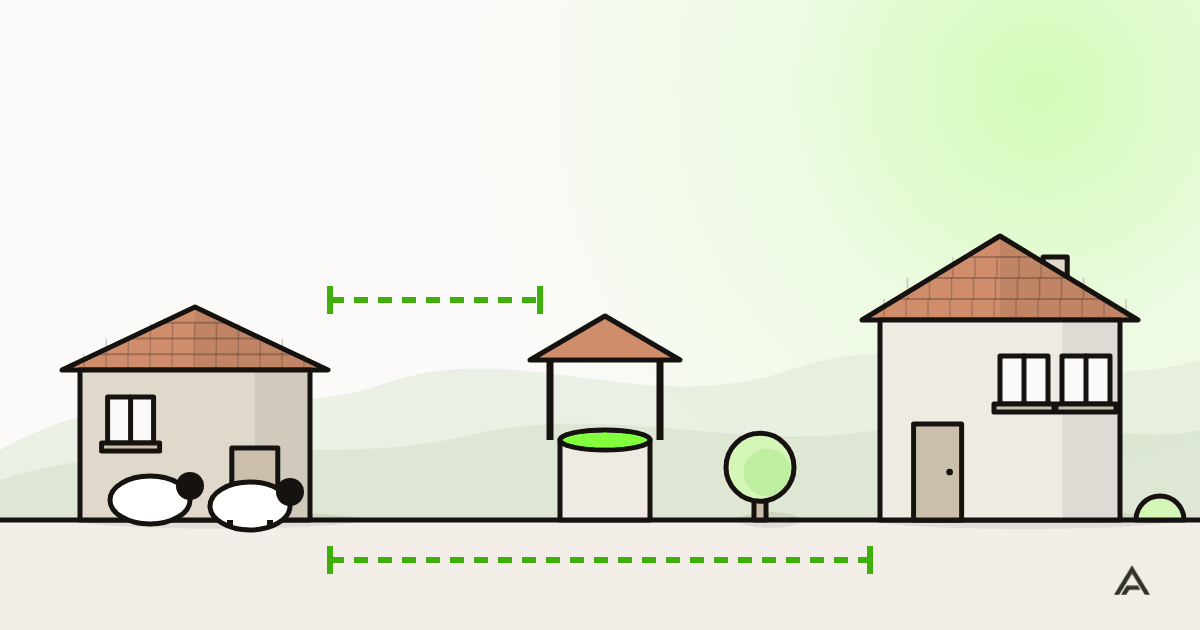
The distance is set by the hygiene norms approved by Order no. 119/2014 of the Minister of Health. They give two figures: 10 metres for a household with few animals and 50 metres above a set number. The distance runs from the shelter to the nearest neighbouring house and to the nearest source of drinking water. Animals are not counted per head but in livestock units (LSU, unități vită mare or UVM in Romanian), using an EU table. Legea 169/2026 comes in only when you ask which permit the shelter needs.
The distances at a glance
| Household | How many animals | Minimum distance | Where it is written |
|---|---|---|---|
| Not connected to a centralised mains water system | up to 6 LSU if you keep several kinds of animal, up to 4 LSU if you keep only hens or pigs | 10 m | the Norms, art. 15(1) |
| Connected to the centralised mains water system | up to 10 LSU, or 7 LSU for hens or pigs only | 10 m | art. 15(2) |
| Any | above those thresholds | 50 m | art. 15(3) |
| The manure platform | in the art. 15(1)-(2) cases / above the thresholds | 10 m / 50 m from the windows of homes and from water sources | art. 38(e) |
| In a town | any number | more, if the local council or a health impact study says so | art. 15(4) |
Paragraphs (1) and (2) measure the 10 m to cea mai apropiată locuință învecinată și sursă de apă destinată consumului uman (the nearest neighbouring dwelling and source of water for human consumption). Our reading: your own house does not count, your own well does, because the text says “water source” without tying it to the neighbour. The same paragraphs require the shelter to be run without polluting and without risk to the neighbours’ health, with biosecurity measures in place.
How many animals make 6 LSU
The Norms refer to the conversion table in Annex II to Commission Implementing Regulation (EU) 2016/669. Each animal is worth a fraction of a unit, and the threshold is compared with the total.
| Animal | LSU per head |
|---|---|
| Bulls, cows and other bovines over two years, equidae over six months | 1.0 |
| Bovines from six months to two years | 0.6 |
| Bovines under six months | 0.4 |
| Sheep and goats | 0.15 |
| Breeding sows over 50 kg | 0.5 |
| Other pigs | 0.3 |
| Laying hens | 0.014 |
| Other poultry | 0.03 |
A few sums to show the scale. Without mains water, the 6 LSU threshold means, for example, two cows and 26 sheep. With laying hens only, the 4 LSU threshold means 285 hens; with pigs only (other than sows), 13 pigs. A household with two cows, ten sheep and 50 laying hens has 2 + 1.5 + 0.7 = 4.2 LSU, so it stays at 10 m. Five cows and twenty sheep make 8 LSU: 50 m without mains water, still 10 m with it.
The table does not list rabbits, dogs or cats, and the Norms do not say how to count them. A yard with a single kind of poultry other than hens, ducks for example, does not fit the wording neatly either: the text has a threshold for several kinds of animal and one for only hens or pigs. Our reading: such cases are not regulated by article 15 and fall under article 20(6) of the same Norms. That paragraph provides for a health impact study if the public health directorate judges there is a risk.
The well is measured separately
Article 27(2) of the Norms requires every well, public or private, to stand at least 10 m, measured radially, from grajd, cotețe, platforme individuale de colectare a gunoiului de grajd, fose septice vidanjabile, latrine (stables, coops, individual manure platforms, emptiable septic tanks, latrines). The rule is written for the well, but it binds the coop owner too: if your neighbour has a well 6 m from the fence, your coop must stand at least 4 m from the fence level with the well, even if their house is far away.
The manure platform also has its own rule, in article 38(e): animal waste from households not treated as farms is collected on sealed platforms at least 10 m de ferestrele locuințelor și sursele de apă (from the windows of homes and from water sources), or 50 m above the article 15 thresholds. The text no longer says neighbouring. Our reading: here the windows of your own house count too. How a septic tank is placed against a well, yours or the neighbour’s, is covered in septic tanks: the legal distance and the permit.
The old stable and the new house
When someone builds a new house next to a stable that has stood for years, the question is who has to move. The Norms answer in article 2(5): when siting new buildings, existing features in the area, such as farms, animal shelters, must be taken into account, respecting both the legal distances and the principle of the oldest location, with a reference to Legea 204/2008 on protecting farms.
Our reading: the duty to keep the distance falls first on whoever builds the new house, not on whoever already had the shelter. Conversely, for a new shelter put up next to an existing house, the house is the older location, and the article 15 distance is kept by whoever builds the shelter.
In a town, the council can raise the figure
Article 15(4) lets urban local councils set, by decision, distances greater than those in the order, according to local circumstances. A health impact study can have the same effect. So 10 m is only the floor: in a town with its own decision, the real distance is the one in that decision.
Before buying animals in a town, ask the city hall whether there is such a decision and which areas it covers. The Norms do not ban animals in towns, but they do not stop a local council from limiting them either.
Which permit the shelter needs
Under Legea 169/2026 a stable is an anexă gospodărească (household outbuilding): the definition in the Code’s annex 1 gives as examples bucătării de vară, grajduri pentru animale mari, pătule, magazii (summer kitchens, stables for large animals, corn cribs, sheds), usually in rural areas. The permit depends on the size and where the plot is, with thresholds at 20, 50 and 150 sq m.
The thresholds are explained in household outbuildings: maximum area and paperwork, and the conditions for works that need no permit on the page on works without a building permit.
Two rules in the Code touch animal shelters, and they pull in different directions:
- No public health opinion is needed for household outbuildings (article 267(2)(b)), except where the law expressly requires a health impact study. The distances in the order still apply without an opinion.
- The exemption from the environmental authority’s act does not apply. Article 268(2)(b) exempts household outbuildings except those used for raising animals. Our reading: for a stable or a coop, the urban planning certificate may ask for the environmental authority’s act.
There is one more line the Norms do not draw: article 11(1) requires a health impact study for farms and breeding units and for animal shelters, including community ones, without saying how many animals turn a household into a breeding unit. Our reading: article 15, written specifically for private yards, is the rule for a household shelter. If you go above its thresholds, ask the public health directorate before you build.
If the neighbour does not keep the distance
The order says, in article 3, that breaching the Norms brings disciplinary, administrative, civil or, where applicable, criminal liability for those at fault. Under article 5, the order is enforced by the county public health directorates and that of Bucharest, local public administration and other authorities involved.
In practice, a written complaint to the public health directorate, with the measured distance and the number of animals, worked out in LSU, is harder to ignore than a complaint about the smell. If the neighbour’s shelter was also built without the required paperwork, the complaint about the building goes separately, to the city hall, following the steps in reporting an unpermitted building.
This article is analysis, not legal advice. The distances cited are from the norms approved by Order 119/2014 of the Minister of Health (consolidated form of 5 May 2026), and the LSU conversion from Commission Implementing Regulation (EU) 2016/669. The Code’s provisions are from Legea 169/2026, published in Monitorul Oficial no. 661 of 10 August 2026. Romanian legal terms are kept in the original where the English would be misleading. Check your own situation with the issuing authority.