
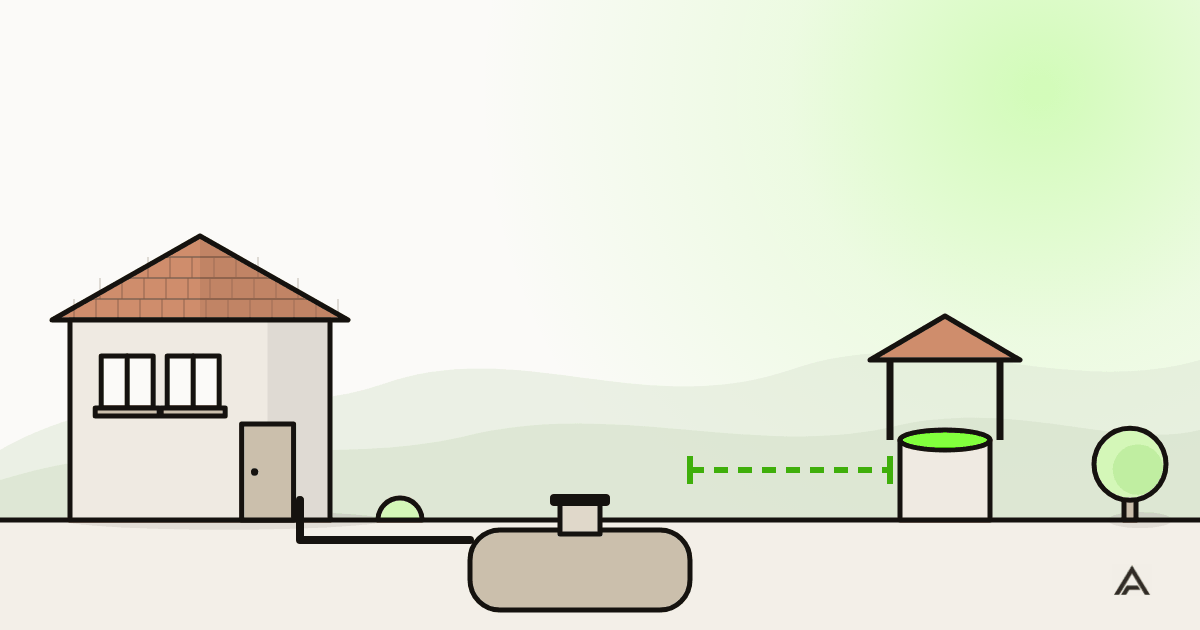
The hygiene rule for siting has a single figure and sits in an order of the Minister of Health, not in the Urban Planning Code: an emptiable septic tank (fosă septică vidanjabilă) goes at least 10 m from the nearest dwelling and from the nearest water source. Legea 169/2026 uses the word fosă only once, for site organisation. It does, however, require that, where there are no public networks, the house’s own sewage installations appear in the house’s design, and that decides, in most cases, how the tank is permitted.
Siting a septic tank: the legal distances
| From what | Minimum distance | Where it is written |
|---|---|---|
| The nearest dwelling | 10 m | the Norms approved by Order 119/2014, art. 34 |
| The nearest water source | 10 m | art. 34 |
| A well, public or private | 10 m, measured radially from the well | art. 27(2) |
| The property line | no specific distance in the Norms; the general Civil Code rule applies | Civil Code, art. 612 |
Article 34 concerns fosele septice vidanjabile prin care sunt îndepărtate apele uzate menajere și fecaloid-menajere provenite de la locuințele neracordate la un sistem de canalizare (emptiable septic tanks taking domestic and faecal waste water from homes not connected to a sewer). It says “the nearest dwelling”, not “the neighbour’s dwelling”. Our reading: the distance also applies to your own house, unlike the rule for animal shelters, where the text expressly says neighbouring dwelling.
The well, yours or the neighbour’s
Article 27(2) of the same Norms puts a well at least 10 m, radially, from grajd, cotețe, platforme individuale de colectare a gunoiului de grajd, fose septice vidanjabile, latrine (stables, coops, manure platforms, emptiable septic tanks, latrines). And article 34 says “water source” without tying it to an owner. The neighbour’s well counts just as much as yours.
On a narrow plot, this is the constraint that decides. If the neighbour’s well is 3 m from the fence, your tank must stand at least 7 m from the fence level with the well, and if you have a well too, the two 10 m circles can leave very little room. The same well also limits a coop or a stable, as shown in how far from houses you can keep animals.
A tank with a bottom, a pit without one
The Norms do not mention bottomless pits. Article 30 does, however, ban răspândirea neorganizată direct pe sol (curți, grădini, străzi, locuri riverane ș.a.) sau în resursele de apă a apelor uzate menajere, fecaloid-menajere și industriale (uncontrolled spreading of domestic, faecal or industrial waste water directly on the ground, in yards, gardens, streets or riverbanks, or into water resources). Our reading: a pit that lets waste water soak into the ground falls under that ban. The 10 m distance in article 34 is written for emptiable tanks, meaning tanks emptied from time to time by a suction truck.
For treatment plants, the Norms set a 50 m distance in article 11(3)(b), for stații de epurare de tip modular (containerizate) (modular, containerised treatment plants). It is measured, however, between protected areas and the perimeter of the units, and the text does not say whether it applies to a small plant next to a single house. Article 28(3) separately requires a public health impact study when designing treatment plants sited within the built-up area, again without distinguishing a town’s plant from a single house’s.
What the Code says about septic tanks
The word appears only once in Legea 169/2026, in site organisation: article 517 requires the site washing ramp to have a water collection system connected to the sewer or to a septic tank. Everything else is said without naming the tank.
Annex 2, which sets out what the building permit design (PAC) contains, asks at point 1.5 for a plan of underground works, and în cazul lipsei unor rețele publice de echipare tehnico-edilitară se vor indica instalațiile proprii, în special cele pentru alimentare cu apă și canalizare (where there are no public utility networks, the property’s own installations are shown, especially for water supply and sewage). For a village house of at most ground floor plus attic and at most 150 sq m of floor area, annex 3 asks, in the summary report, for the solutions for equipping the plot with utilities (point 7(c)); the plan at point 4 covers only connections to existing networks, made on public land.
In short: if you build a new house where there is no sewer, the tank appears in the design and is permitted together with the house, following the steps on the page about the building permit. The 10 m distance is checked then, on the site plan.
A new tank for an existing house
Here the Code gives no direct answer. The general rule is in article 245: building is done on the basis of a permit, and notification and works with no formality are exceptions. The list of works needing no formality at all, in article 299(2), includes branșamentele și racordurile exterioare, de orice fel, aferente construcțiilor, în limitele proprietății (outdoor connections of any kind serving the buildings, within the property; point (b)3) and repairs to them (point (a)9). The tank is not there. Annex 1 does, however, define instalațiile aferente construcțiilor (installations serving buildings): the equipment providing utilities, inside the property line, from the connection to the users, which se autorizează împreună cu acestea sau, după caz, separat (are permitted together with the buildings or, where appropriate, separately).
Our reading: a septic tank is a buried tank, not a connection to a network, so it does not fit the article 299 exception. It is an installation serving the house, permitted separately when not built with it, so a new tank needs a building permit. Replacing an old tank with a new one in the same place is harder to classify, and the text does not settle it. The cheapest route is to apply for an urban planning certificate describing the work exactly: the city hall’s answer tells you which permit you need before you dig. How the connections exception works where it does apply is shown in electricity connections without a building permit.
The distance from the fence is not in the hygiene Norms. The Civil Code, in article 612, requires at least 60 cm from the boundary line for any construction or works, unless the law or the urban planning regulation provides otherwise; the details are in how close to your neighbour you can build.
The 10 m circles on your plot plan
Draw 10 m circles on a simple plan of the plot: around your house, around the nearest neighbouring house and around every well, including the neighbour’s. The tank fits only in the area left free, and the emptying truck has to reach it. If no room is left, the only options are a connection to a network, if one exists, or a talk with the public health directorate about a treatment solution, before you buy.
This article is analysis, not legal advice. The distances cited are from the norms approved by Order 119/2014 of the Minister of Health (consolidated form of 5 May 2026). The Code’s provisions are from Legea 169/2026, published in Monitorul Oficial no. 661 of 10 August 2026, and the 60 cm rule from the Civil Code. Romanian legal terms are kept in the original where the English would be misleading. Check your own situation with the issuing authority.