
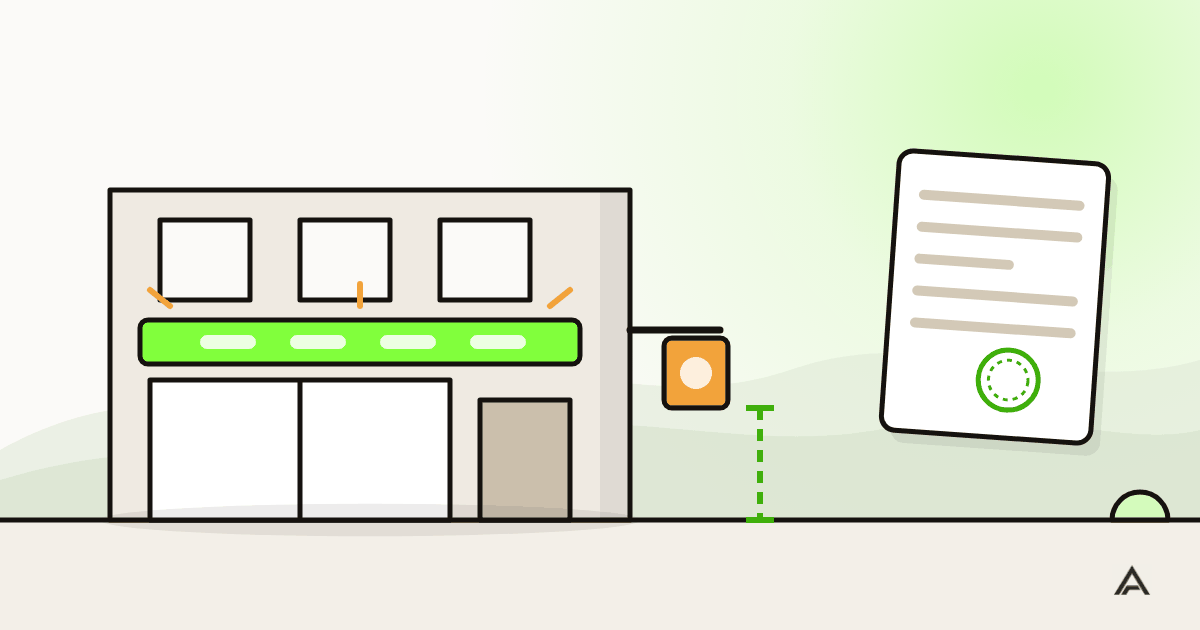
Two laws together answer which document a shop sign needs. Legea 185/2013 on the siting and authorisation of advertising media says which document you need and where the sign (firmă) can go. The Urbanism Code (Legea 169/2026) says what kind of construction the sign is and how long it may stay. In short: a sign mounted on the facade needs a building permit (autorizație de construire), lettering on the shop window or the door needs only an approval (aviz), and the annual display tax is paid separately from both.
The document, by what you put up
| What you put up | Document | Where it says so |
|---|---|---|
| Sign on the facade, projecting, or on an awning | Building permit, for a limited period | L185 art. 4 para. (1)-(2), art. 19 para. (1) |
| Lettering on the shop window or the entrance door | Town hall approval, no building permit | L185 art. 19 para. (2)-(4) |
| Illuminated panel or advertising on a facade, terrace or roof | Permit, based on a technical expert report and a checked design | L185 art. 23 para. (4) |
| Free-standing advertising panel with a foundation | Building permit | L185 art. 4 para. (1), art. 49 para. (1) lit. a) |
| Temporary advertising on the ground, no foundation, at most 30 days | Town hall approval, renewable once | L185 art. 6, art. 7 para. (1) |
| Advertising inside the shop | No display tax is due | Fiscal Code art. 479 para. (3) |
A shop sign is a temporary construction
Annex 1 of the Urbanism Code lists signs and advertisements among temporary constructions, alongside kiosks, display panels and awnings. Legea 185/2013 says the same thing from its own angle: approving the siting, execution and keeping of advertising media on building facades or on a structure of their own is done only through a building permit (article 4 paragraph (1)), and the permit states their provisional character and duration (paragraph (2)).
The duration has a ceiling in the Code: for temporary constructions, the service life is set by the permit and may not exceed 5 years, with the exceptions provided by the Code (article 368 paragraph (3) letter d)). When the term expires and has not been extended, article 5 of Legea 185/2013 requires you to remove the sign and return the facade to its previous state. If you do not, the mayor orders its removal by administrative means, within 30 days at most, without a demolition permit and without a court, at the expense of the owner of the advertising support. The general regime of provisional constructions, with the fine for keeping them after the term, is explained in container or house on wheels: which permit.
Legea 185/2013, republished in 2018, refers to Legea 350/2001, which the Urbanism Code repealed. Article 583 paragraph (3) of the Code settles this: any reference in a special law to repealed provisions is read, from the Code’s entry into force, as a reference to the Code.
On the shop window: an approval, not a permit
Letters stuck or painted on the shop window or on the entrance door are the exception to the building-permit rule. Article 19 paragraph (2) says no building permit is needed for them, paragraph (3) requires the approval of the public administration, and paragraph (4) makes putting them up conditional on paying the advertising taxes.
The practical difference is large. The approval needs no building permit, and our reading is that it needs no urbanism certificate (certificat de urbanism) either, since that certificate is issued for the permit. The law’s definition of the approval, written for temporary advertising, ties it to a review of a technical design (article 3 letter b)); for letters on the window, the law does not say which documents are required. Letters on the window are allowed, but covering glazed surfaces with any advertising medium is banned (article 15 paragraph (2)), so the window cannot become a billboard. If your sign can live on the window, that is the shortest route. If you want the letters on the facade, above the door, even a few centimetres from the glass, you have moved to a permit.
Where the sign can go and how high
The law fixes where the sign sits on the building, how low it may hang and how far it may project, and an illuminated sign also has a minimum height and limits near traffic lights. Check them all on the drawing before ordering anything from the sign maker:
- On a block of flats with commercial units on the ground floor, the sign goes only on the part of the facade belonging to your unit or on the solid parapet of the first floor, with the owners’ consent (article 18 paragraph (1) letter a)).
- A projecting sign starts at least 2.50 m above the pavement, projects at most 1.20 m from the facade and stays at least 1.00 m from the kerb line (letter b)).
- A lettered awning also sits at least 2.50 m up, projects at most 1.50 m and keeps the same 1.00 m from the kerb (letter c)).
- An illuminated sign is mounted at least 3.00 m above the ground; within 30 m of traffic lights or road signs it may not use their colours or flashing light (article 21 paragraphs (2)-(3)).
Location matters just as much. Municipalities, towns and communes with UNESCO-listed monuments must have a local advertising regulation, with restricted and extended advertising zones (article 8). Protected built-up zones, historic centres and monuments’ protection zones are restricted zones, and they can contain areas where all advertising is banned except shop signs, whose shape and size the chief architect (arhitect-șef) or the town hall’s urban planning officer approves (article 9 paragraphs (3)-(4)). On a historic monument, advertising is banned except for the sign announcing the activity inside the building and mesh banners during consolidation or restoration works (article 15 paragraph (1) letter h)).
Illuminated signs: when an expert report is required
Article 23 paragraph (4) requires, for advertising panels, screens and illuminated advertising on buildings, a technical expert report by certified experts and a design checked for mechanical strength and stability, safety in use and fire safety. Paragraph (5) requires a new expert report every 10 years from the permit.
The law deals with shop signs in a separate section from panels and illuminated advertising, so the text does not say directly whether a sign with illuminated letters falls under paragraph (4). Our reading is that a large light box anchored to the facade comes close to illuminated advertising as defined in article 3 letter p), while small back-lit letters are closer to an ordinary shop sign. The answer for your case comes from the list of documents in the urbanism certificate, before you pay the expert.
Separately, the anchoring systems of advertising media on existing buildings fall under monitoring of behaviour in service, with an inspection report drawn up at least once every 2 years by an expert certified for mechanical strength and stability and sent, through the owner, to the county construction inspectorate (article 5 paragraph (4)). It is a recurring cost to budget for with the sign.
The public health opinion is not needed for placing advertising media (article 267 paragraph (2) letter d) of the Urbanism Code), except where the law expressly requires a health impact study, so leave it off your list unless the urbanism certificate asks for it.
If the unit is rented
Most shops are not in premises they own. The Code allows temporary constructions on the basis of a contractual right, for example a lease, with the owner’s consent (article 245 paragraph (4) letter a)). As the sign is a temporary construction, our reading is that the tenant can hold the permit, with the building owner’s written consent.
What else a lease allows, and what it does not, is explained in building permit on leased land.
Legea 185/2013 also places a duty on the owner who gave consent: they must ask whoever builds the advertising support for the building permit (article 4 paragraph (4)). So the building owner is not a bystander if the sign goes up without papers.
Taxes: three separate lines in the Fiscal Code
A sign can attract three different local taxes: a fee when the permit is issued, an annual display tax for as long as the sign is up, and a tax on advertising services, which applies only if you buy advertising from someone else:
- The permit fee. For signs and advertisements on public roads and public spaces, the Fiscal Code sets an amount of up to 8 lei per square metre occupied (article 474 paragraph (14)). Our reading is that for a sign fixed to the facade of a private building this line does not apply (a projecting sign over the pavement is less clear) and the general rule of paragraph (6) remains, 1% of the value of the works. The other permit fees are calculated on the page on permit fees.
- The display tax, annual, per square metre: the Fiscal Code says up to 32 lei for display at the place where you carry on your business and up to 23 lei for any other panel, amounts set by the local council (article 478 paragraph (2)). The return is filed within 30 days of putting the sign up (paragraph (5)), and the tax is paid in two instalments, by 31 March and 30 September (paragraph (4)); a total of up to 50 lei owed to the same local budget is paid in full by 31 March. The tax is recalculated for the months the sign is displayed (paragraph (3)). No display tax is due on advertising inside buildings (article 479 paragraph (3)).
- The tax on advertising services, between 1% and 3% of the contract value excluding VAT, at a rate set by the local council, is owed when you buy advertising (other than in the press, radio, television or online), for example when you rent a billboard, but the provider declares it and pays it over (article 477).
The fixed amounts above (8, 32 and 23 lei) are the ones written in the Fiscal Code. Local councils index them every year for inflation (article 491 paragraph (1)), so the figure in your town hall’s decision can be higher. The exact amount is in the local council’s decision on local taxes for the current year.
Fines and regularisation: the special law has small amounts, the Code does not
Legea 185/2013 fines temporary advertising put up without approval, and free-standing panels with a foundation put up without a building permit, 1,000 to 10,000 lei, and illuminated advertising that may disturb traffic 1,000 to 20,000 lei (article 49). Since July 2026, article 50 paragraph (2), added by Legea 152/2026, applies Government Ordinance no. 2/2001 to these offences.
For a facade sign put up without a permit, Legea 185/2013 has no offence of its own. Our reading is that the general text that describes the act is article 357 paragraph (1) letter b) of the Code, works carried out without a building permit, with a fine between 50,000 and 1,000,000 lei (paragraph (4) letter b)). The contrast with the free-standing panel, fined at most 10,000 lei, shows that the two laws were not calibrated against each other.
On a historic monument, in its protection zone or in a protected built-up zone, our reading is that the same act is a crime, not an administrative offence: 3 months to 1 year in prison or a criminal fine (article 356 paragraph (1) letter a)). The offences in article 357 apply only to acts that are not crimes (paragraph (1)).
Regularisation is possible but expensive and conditional: article 301 paragraph (2) does not include signs, so for a sign only the one-year window from the Code’s entry into force, on 25 August 2026, remains (paragraph (7)). It is open to constructions outside that list if they comply with the approved planning rules and the quality requirements and the tax obligations and the penalties have been met, so the fine does not go away. The state control levies and the permit fees are ten times higher (paragraph (8)). The details are in the one-year window for regularisation.
The steps, from the local regulation to the tax return
Order matters: the local regulation says whether a sign is allowed there, consents come before the application, and the tax return and the permit’s expiry still concern you after the sign is up.
- Read your town’s local advertising regulation and check whether the address is in a restricted zone or in an area where only shop signs are allowed. In that area, the chief architect or the urban planning officer approves the sign’s shape and size.
- Get the consents: from the owners, on a block of flats, and from the building owner, if you are a tenant.
- Pick the place: on the window, with an approval, or on the facade, with a permit. Measure the dimensions above on the real facade.
- Ask for the urbanism certificate and the permit, with the design and, for an illuminated sign on a building, with the expert report if the certificate requires it. The general steps are on the page on the building permit.
- Declare the sign for the display tax within 30 days of putting it up, and note the date the permit expires, so you ask for the extension in time.
This article is analysis, not legal advice. The provisions cited are from Legea 185/2013, republished in Monitorul Oficial no. 147 of 15 February 2018 (consolidated text of 24 July 2026), from Legea 169/2026, published in Monitorul Oficial no. 661 of 10 August 2026, and from the Fiscal Code (consolidated text of 25 October 2026). Romanian legal terms are kept in the original where the English would be misleading. Check your own situation with the issuing authority.