
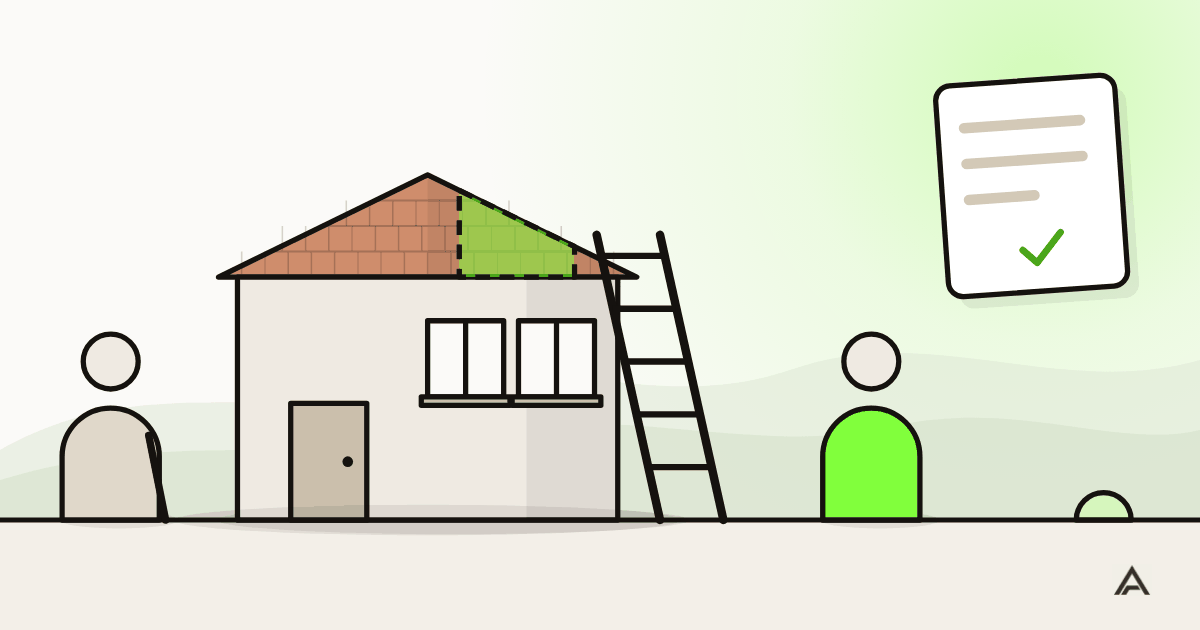
A life usufruct (uzufruct viager) gives a person the right to use a house for the rest of their life, with a duty to preserve its substance, while the owner keeps the bare ownership (Civil Code, arts. 703 and 708). For works, the Civil Code splits the burden: the usufructuary carries out maintenance repairs, and the major repairs, such as those to the structure, walls, roof and installations, fall on the bare owner unless skipped maintenance caused them (art. 729). For works the usufructuary adds without the bare owner’s approval, the bare owner may ask for their removal and for the house to be restored (art. 716(2)). The Urbanism Code never mentions usufruct; our reading is that the simplest route is for the bare owner to apply for the permit, with the usufructuary’s written consent.
Who does what, by type of work
| The work | Who carries it out and pays | The other party’s consent | Where |
|---|---|---|---|
| Maintenance repairs | The usufructuary | Not required by the Civil Code | Civil Code, art. 729(1) |
| Major repairs (an important part of the house, exceptional expense): load-bearing structure, walls, roof, installations | The bare owner, once told by the usufructuary; the usufructuary, if skipped maintenance caused them | The usufructuary may do them if the owner is late, and gets the money back | Civil Code, art. 729(2)-(4), art. 730 |
| New works added by the usufructuary: extension, attic conversion, outbuilding | The usufructuary | The bare owner’s approval, otherwise the owner may ask for the works to be removed; for a stand-alone outbuilding, the accession rules | Civil Code, art. 716 |
| What age or an unforeseeable event destroyed | Nobody is obliged to rebuild | - | Civil Code, art. 731 |
Life usufruct in short
Usufruct is the right to use someone else’s property and take its fruits, just as the owner would, but with the duty to preserve its substance (art. 703). For a natural person it lasts at most for their lifetime, and if the deed does not say how long, it is presumed to be for life (art. 708(1) and (3)). The usufructuary has exclusive use of the house unless the deed provides otherwise (art. 709).
The typical case: parents give or sell the house to their children and keep the usufruct. The Civil Code foresees exactly this when it exempts from lodging security the seller and the donor who have reserved the right of usufruct (art. 726(2)). The child becomes the bare owner, the parent goes on living in the house, and the question of who pays and who applies for the permit comes up with the first leaking roof or the first extension.
Major repairs fall on the bare owner
Article 729 sets the split. The usufructuary must carry out maintenance repairs (para. (1)), and major repairs fall on the bare owner (para. (2)). The text defines them as repairs concerning an important part of the property and involving exceptional expense, with examples for buildings: strengthening or rehabilitating the load-bearing structure, interior and exterior walls, the roof, and the electrical, heating and plumbing installations (para. (3)).
Two exceptions change the sums. If a major repair became necessary because the usufructuary skipped maintenance, it falls on the usufructuary (para. (4)). If the bare owner does not carry out a major repair in time, the usufructuary may do it at their own expense after telling the owner; the owner repays the money by the end of the year, updated to the date of payment (art. 730).
Neither is obliged to rebuild what was destroyed by age or by an unforeseeable event (art. 731). Our reading: a roof destroyed by age obliges nobody to rebuild it, although in practice someone will if anyone is to live there. Where an article 729 major repair ends and article 731 destruction begins, the Civil Code does not say.
New works by the usufructuary
Article 716 deals with what the usufructuary adds to the house. When the usufruct ends, the usufructuary cannot claim compensation for works added, except necessary ones, even if they increased the house’s value (para. (1)). If they were made without the bare owner’s approval, the bare owner may ask for them to be removed and the house restored to the state in which it was handed over (para. (2)). For necessary works, and for works made with the owner’s approval that increased the value, the usufructuary may claim fair compensation (para. (3)). For stand-alone structures, such as a new outbuilding in the yard, the rules on accession apply unless the deed or the law provides otherwise (para. (4)).
Before an extension, an attic conversion or an outbuilding, the usufructuary should therefore get the bare owner’s approval, and written approval is easier to prove. What the Urbanism Code requires for an extension is in extending an existing house.
Who applies for the urbanism certificate and the permit
Our reading: the usufructuary may apply for the urbanism certificate, but the permit for a particular work needs the bare owner’s consent, and the shortest route is for the bare owner to file, as owner, with the usufructuary’s written consent for a work that affects the usufructuary’s use. The Urbanism Code never mentions usufruct; it uses formulas that take it in or leave it out, depending on the article:
- the urbanism certificate is issued to the holder of a real right over the property (art. 257(1)), and usufruct is a real right (Civil Code, art. 551, point 3);
- building works may be carried out by owners and by holders of real rights corresponding to public property, in compliance with the legal act that created the right or with the owner’s consent (Legea 169/2026, art. 245(3));
- the permit file includes the documents proving ownership or another real right or personal claim that allows the applicant to build (art. 262(1)(b));
- a notification is sent by the holder of a principal real right or of a personal claim (art. 295(2)).
The reason, again on our reading: usufruct alone does not allow building, because it carries a duty to preserve the substance of the house. What makes it allow a particular work is the bare owner’s consent, on the model of the owner’s-consent route in article 245(3). With that consent, either the usufructuary or the bare owner can file.
The forms do not help: neither the urbanism certificate application (F_CU_04), nor the notification (F_NOT_01), nor the permit application (F_A_01) in Order 975/2026 has a box for usufruct. The documents each of them files are on the urbanism certificate application page.
Which document the work needs
The Civil Code’s split tells you who pays. The document for the work is set by the Urbanism Code, according to the type of work, and it is the same whoever does it: replacing the roof in the same shape can go by notification, while strengthening the structure needs a building permit.
Notification for the roof applies outside protected built-up areas and monument protection zones, within the height limits of the local regulation (Legea 169/2026, art. 294(2)(b)(ii)); the conditions are in roof, windows and facade without a permit. Strengthening is not on the list of works that go by notification, and the urbanism certificate may ask for a technical expert report, described in technical expert reports for existing buildings.
When a life usufruct ends
A life usufruct ends when the usufructuary dies (Civil Code, art. 746(1)(a) and (2)). It also ends by merger, when the same person becomes usufructuary and bare owner, by waiver, or by non-use for 10 years (para. (1)(c)-(e)). For real estate the land book rules apply (para. (3)), so the usufruct is struck off at the land book office.
Usufruct can also be lost earlier. If the usufructuary abuses the use, damages the property or lets it fall into disrepair, the bare owner may ask for the usufruct to end (art. 747(1)). The court may order it extinguished, or let the bare owner take over the use of the house and pay the usufructuary an annuity for the length of the usufruct (para. (3)).
This article is analysis, not legal advice. The provisions cited are from the Civil Code (Law 287/2009), from Legea 169/2026, published in Monitorul Oficial no. 661 of 10 August 2026 (with the rectification in Monitorul Oficial no. 862 of 14 October 2026), and from Order 975/2026. Romanian legal terms are kept in the original where the English would be misleading. Check your own situation with the issuing authority.