
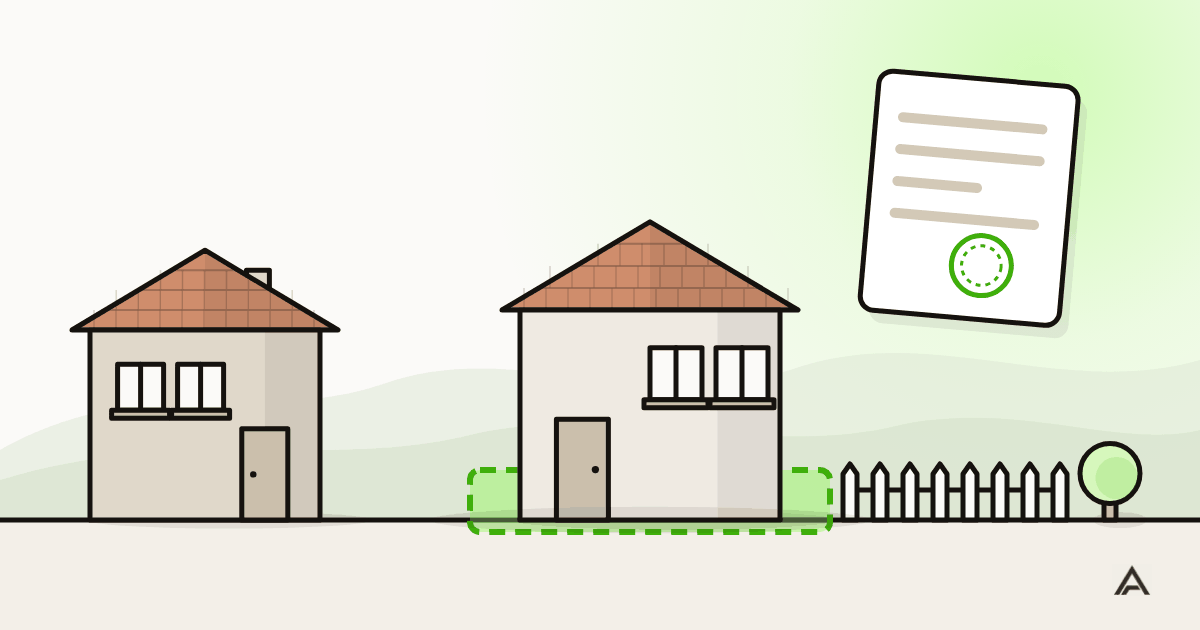
The right of superficies (drept de superficie) is the right to have or to put up a building on land that belongs to someone else (Civil Code, art. 693(1)). The land stays with its owner, the house is yours. The usual case is a house built on your parents’ land without the land being put in your name. By contract, superficies is created before a notary and entered in the land book. The permit application form has no box with its name, and the Urbanism Code does not name the holder in its article on who may build. Our reading is that superficies still lets you apply for the permit, with the contract attached to the file.
Which title you hold and what it lets you build
| Your situation | The right you hold | What you can build | Where |
|---|---|---|---|
| The land is yours | Ownership | Whatever the permit allows | Legea 169/2026, art. 245(3) |
| You hold superficies over someone else’s land | A real right over someone else’s land | The building described in the deed that created it | Civil Code, arts. 693, 695(1); Legea 169/2026, art. 262(1)(b) |
| You hold a concession over public land | A real right corresponding to public property | What the concession deed allows | Legea 169/2026, art. 245(3) |
| You only have a lease or a loan for use | A personal claim (drept de creanță) | Temporary structures, repairs to permanent buildings, non-structural removable interior partitions, with the owner’s consent | Legea 169/2026, art. 245(4)(a) |
What superficies is
The Civil Code defines it as the right to have or to build a structure on someone else’s land, above or below that land, together with a right to use the land (art. 693(1)). It can be acquired by a legal act, by acquisitive prescription or in any other way the law provides (para. (2)), and in the list of real rights it comes straight after ownership (art. 551, point 2).
It lasts at most 99 years and can be renewed (art. 694). For a house, the practical effect is that ownership splits: the law presumes that a building belongs to the owner of the land, but the presumption can be rebutted, among other cases, where a right of superficies has been created (art. 579(2)).
Superficies can be paid for or free. Where it is granted for consideration and the parties agreed nothing else, the holder owes a monthly sum equal to the market rent of the land (art. 697(1)). Between parents and children it is often granted free of charge, and it is worth writing that into the contract.
For a mortgage, article 695(4) matters: while the house stands, the right to use the land can be sold or mortgaged only together with the ownership of the house.
The superficies contract, before a notary
A contract that creates a real right to be entered in the land book must be made as an authenticated deed, on pain of absolute nullity (Civil Code, art. 1244). Superficies falls into that category: the land book provisions remain applicable (art. 693(2)). An agreement written at the kitchen table is not enough.
What the contract says matters for the permit too. Superficies is exercised within the limits and on the conditions of the constituting act (art. 695(1)); unless the deed says otherwise, it covers the land built on and the land needed to use the building. For owners and for holders of real rights corresponding to public property, the Urbanism Code ties building to compliance with the legal act that created the right or to the owner’s consent (Legea 169/2026, art. 245(3)). Our reading is that the same logic applies to superficies: if the contract describes the building you file for, it covers the project; if it does not describe the building, the landowner’s written consent is the safe option.
Where superficies appears in the Urbanism Code
The Urbanism Code names superficies only once, for contracts to extend ground-floor spaces of blocks of flats onto the flat owners’ land (art. 325(4)). Article 245(3), which says who may carry out building works, names the holders of the right of ownership and the holders of other real rights corresponding to public property. The Civil Code lists those: the right of administration, the right of concession and the right of use free of charge (art. 866). Superficies over private land is not on that list.
The other articles, however, use a wider formula:
- the urbanism certificate is issued to the holder of a real right over the property (art. 257(1));
- the permit file includes the documents proving ownership or another real right or personal claim that allows the applicant to build (art. 262(1)(b));
- the beneficiary is the person who holds a principal real right or a personal claim over the property (art. 420(1));
- a notification is sent by the holder of a principal real right or of a personal claim (art. 295(2)).
Our reading is that superficies entitles you to apply for the urbanism certificate and for the permit: it is a real right, and its whole purpose, under the Civil Code’s definition, is building. Articles 257, 262 and 420 take it in. Article 248(1), however, ties the issuing of the permit to the holders listed in article 245, which is why this remains a reading.
The general rule on which title a permit needs, including why a lease is not enough for a house, is in which right over the land a building permit needs.
The form has no box for superficies
The building permit application, form F_A_01 in Order 975/2026, asks in section 3 which right you hold and offers four options: ownership of the property, another real right corresponding to public property, a personal claim, and another right under art. 248(2), which covers engineering works of public interest. None of them describes superficies over private land. The urbanism certificate application for building works, F_CU_04, has only two: holder of the right of ownership, or the holder’s authorised representative.
On the permit form, the superficies contract goes under point 10(b), where you attach the documents proving the right on which the holder may apply. How to fill in the rest of the application is on the building permit application page. For the missing box, ask the town hall’s registry which option they want you to tick and get the answer in writing. Our reading: if the landowner also signs the application or gives you written consent for the project, the file also rests on the owner’s-consent route in article 245(3).
If you have already built on your parents’ land
Superficies can still be registered after the house is built: on the basis of the landowner waiving the right to invoke accession in favour of whoever built (Civil Code, art. 693(4)). Without it, the law gives the building to the owner of the land (art. 577(1)) and presumes the owner built it, until proven otherwise (art. 579).
Registering superficies settles who owns the house and by what right it stands on the land, not whether you can register the house itself in the land book. For a building put up long ago without a permit, the document that matters at the land book is the certificate attesting the building’s construction.
What happens to the house when superficies ends
When the term expires, unless the contract says otherwise, the landowner becomes the owner of the house and owes you its market value (art. 699(1)). If the house did not exist yet when the right was created and its value has become at least equal to that of the land, the landowner may ask you to buy the land. You can refuse only if you remove the house at your own cost and restore the land to its earlier state (para. (2)).
Superficies is extinguished by being struck off the land book, for one of these causes: expiry of its term, merger (the land and the house end up with the same person), destruction of the building where the contract expressly provides for it, or other cases set by law (art. 698).
Superficies or the land in your name
Superficies keeps the land with your parents and gives you the house. If the land is transferred to you, the permit application gets simpler: where the owner shown on the land book extract is the applicant, no further documents proving ownership are needed (Legea 169/2026, art. 262(1)(b)). The choice between the two is for the family, the notary and the way you want to split land and house.
This article is analysis, not legal advice. The provisions cited are from the Civil Code (Law 287/2009), from Legea 169/2026, published in Monitorul Oficial no. 661 of 10 August 2026 (with the rectification in Monitorul Oficial no. 862 of 14 October 2026), and from Order 975/2026. Romanian legal terms are kept in the original where the English would be misleading. Check your own situation with the issuing authority.