
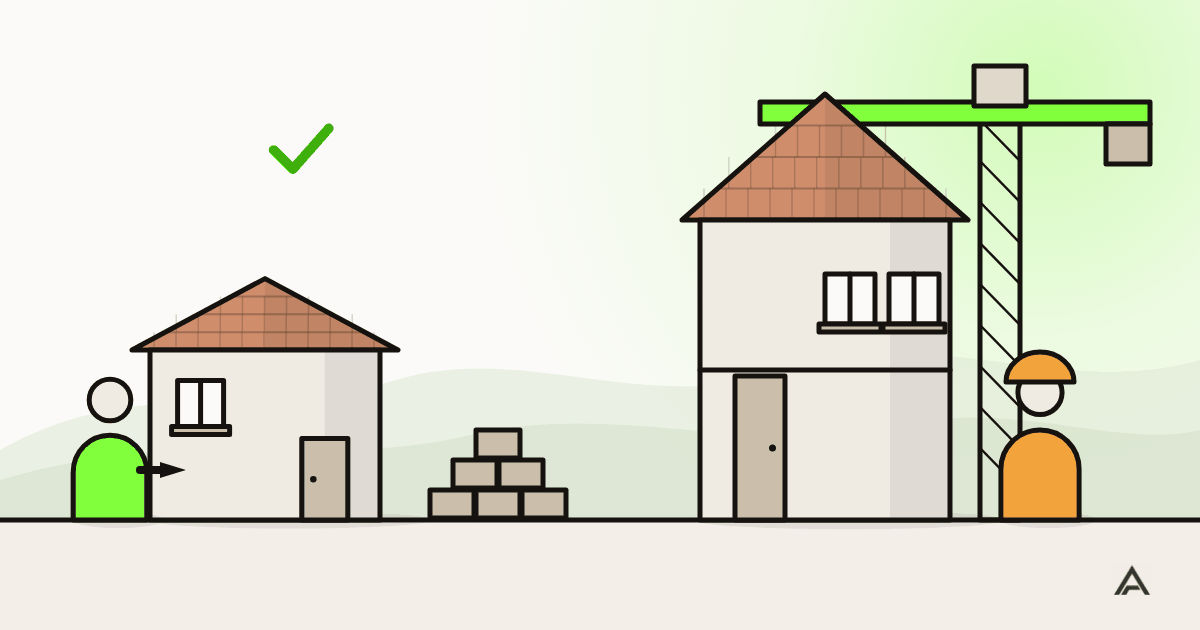
Since 25 August 2026, of the buildings that need a building permit, you may build in regie proprie, without a contractor, only a ground-floor house in a rural area, a garage, a terrace or a ground-floor household annex. A house in a town, or any house with an upper floor, must be built by a contractor (article 279(1) of the Urbanism Code). On an existing building, you may still do maintenance and routine repairs without a firm (article 285(1)). Notified works and site works have their own rule, explained below. The Ministry of Development read the text the same way, in a set of clarifications published in October 2026.
What you may build without a contractor
Without a contractor, and with a permit, you can still build only a ground-floor village house, a garage, a terrace or a ground-floor household annex, and on existing buildings do maintenance and routine repairs. Notified works and site works are a category of their own.
| The works | Without a contractor? | Where it is written |
|---|---|---|
| Ground-floor house, in a rural area | Yes | Art. 279(1) |
| House in a town, even a ground-floor one | No | Art. 279(1) |
| House with an upper floor, in a town or a village | No | Art. 279(1) |
| Garage, terrace, ground-floor household annex, in a town or a village | Yes | Art. 279(1) |
| Any other new building | No, except notified works (see below) | Art. 279(1) |
| Maintenance and routine repairs on an existing building | Yes | Art. 285(1) |
| Other works on an existing building | No, except notified works (see below) | Art. 285(1) |
| Landscaping and site works (lucrări de amenajări) | Yes | Art. 292(2) |
| Works done under a notification | Yes, according to the ministry | Art. 298(4) |
The table is about who carries out the works. Whether you need a permit, a notification or nothing at all is a separate question, answered by other articles of the Code.
New buildings: the list in article 279
Article 279(1) has two sentences. The first says that building works are carried out by contractors or in regie proprie. The second narrows the option without a firm straight away: only ground-floor houses in rural areas, garages, terraces and ground-floor household annexes may be built in regie proprie. For any other category of building, the sentence adds that building without a firm is prohibited, whatever the consequence class.
The list is closed, and the prohibition is written out. The ministry was asked whether this is still possible in towns and answered along the same line, for new buildings that need a building permit: garages, terraces and ground-floor household annexes may be built without a contractor in both urban and rural areas, ground-floor houses only in rural areas.
Several words in the list are defined in annex no. 1 to the Code. Household annexes are the buildings in the yard of a household that serve the dwelling, and the definition gives summer kitchens, sheds, garages, greenhouses, polytunnels and swimming pools as examples. The ground floor is the level that gives the main access to the building, the one marked ±0.00. A terrace is defined there as the horizontal surface that closes a building at the top, in other words a flat roof. That does not fit a terrace built on its own in the yard, and the Code does not say which terraces article 279 means. Regie proprie itself has no definition in the Code. The phrase appears only in articles 279, 280, 285, 292 and 298.
Article 279 does not say how a village that belongs administratively to a town is classed. Annex no. 1 defines a village as a rural locality, but article 466(5) names the rural area and villages belonging to municipalities and towns separately. If your plot is in such a village, ask the town hall for a written answer before you decide to build without one.
A town house or a house with an upper floor needs a contractor
For a house in a town, even a ground-floor one, and for any house with an upper floor, the Code no longer leaves the option of building with your own hands. The works go to a contractor, who supervises the execution permanently through its technical manager for execution (article 520(3)(a)).
That changes the budget and the paperwork from the start. You need a written contract with the firm, which we covered in the construction contract for a house. The roles on site, yours and the firm’s, are in the site supervisor and the technical manager for execution.
On an existing building: maintenance and routine repairs
Article 285(1) is built the same way as article 279. Works on existing buildings are carried out by contractors or with the owner’s own labour, on the basis of a checked technical design. Then comes the limit: only maintenance and routine repair works may be carried out in regie proprie. Any other type of intervention on an existing building is prohibited without a firm, whatever the consequence class. Annex no. 1 describes routine repairs as maintenance works: painting, decorating, repairing minor parts.
The ministry repeats the rule and adds that it applies the same in towns and villages. Anything beyond maintenance and routine repairs is done with a firm, outside notified works, covered below. We explained the Code’s definition in what counts as an intervention.
Notified works and site works stay open
For two categories, the Code leaves both options without a restrictive list. Landscaping and site works are carried out by contractors or with your own labour, on the basis of a checked technical design (article 292(2)). Building works notified under article 294 may be carried out either way as well (article 298(4)).
Here the provisions clash. The works that go by notification include a village house with a semi-basement and a ground floor, of up to 150 sq m of total floor area, and several interventions on existing buildings, such as converting a loft into an attic room. The semi-basement counts among the above-ground levels (annex no. 1), so the house is no longer ground floor only. Articles 279 and 285 would forbid these works without a firm, and article 298 allows them. The Code does not say which rule prevails.
The ministry answered that works that may be done through the notification procedure may be carried out both without a firm and by contractors. In the same answer, it ties the limit in article 279 to new buildings that need a building permit. Our reading: with that link, notified works stay under article 298. The ministry’s answer supports this, but it does not have the force of law. State in the notification how you will carry out the works and keep proof of filing and any reply from the town hall. You can check whether your works qualify for notification on the page about the simplified notification.
How much weight the ministry’s clarification carries
The clarification does not have the force of law. It is part of the second set of clarifications on the Code, published by the Ministry of Development in October 2026, a six-question document with no number, not issued as an order.
The ministry posted it on its page about the Code and, in a letter of 19 October 2026, asked the Ministry of Internal Affairs to disseminate it, as it had the first set, which went to local authorities through the prefectures. The difference from an order matters. Article 578(2) lets the ministry issue orders, instructions, guides and other acts of a technical, interpretative or administrative nature. For enclosed balconies it chose an order, as we showed in our analysis of Order 1389/2026. The clarifications show how the ministry reads the text and how town halls are likely to apply it. Our reading: you can cite them at the counter, but a court reads the Code itself.
A permit issued before 25 August 2026
If you hold a building permit issued before the Code took effect, the ministry says that how you carry out the works, with a firm or without, stays subject to the law in force on the date the permit was issued. According to the ministry, a house permitted under the old law and started with your own hands continues under the rules of that time. The ministry cites no article of the Code for this. Keep the permit, which proves its date, in the site file.
Documents you need to build your house yourself (regie proprie)
Without a firm, the basic documents stay the same: the building permit (or the notification, where the law allows it), the technical design for execution, which the ministry requires however you work, unless the law provides otherwise, and the acceptance on completion of works. The mandatory insurance stays too. Only your own insurance as the beneficiary is not mandatory if you build your own single-family home and will use it yourself, for a single home, once.
- The design. The ministry states that works may be carried out only on the basis of a technical design for execution, whichever way you work, unless the law provides otherwise.
- The acceptance. Acceptance on completion of the works is compulsory even when you build yourself (article 280(2)). The steps are in acceptance of a house built without a contractor.
- The insurance. The insurance policies in article 279(2) remain compulsory. Only a beneficiary building their own single-family home, to be used by them, is exempt, for one home only, once (paragraphs (3) and (4)).
What you risk building without a firm outside the list
None of the five articles that name regie proprie sets a fine. The nearest text is in the list of offences in article 570: carrying out construction without authorised technical managers for execution, in paragraph (1)(o), fined from 20,000 to 50,000 lei (paragraph (2)(b)). Our reading: a building put up without a contractor where the Code requires one may be treated that way, but the text does not make the link itself.
Our reading: the more concrete risk comes at the end. Acceptance and land-book registration rely on the execution records, and works done by someone who was not allowed to do them start with a file that is hard to defend.
Before you decide
- Pin down what you are building: a house or an annex, ground floor or with an upper floor, in a village or a town.
- Check the procedure: a permit, a notification or no formality at all.
- If the works are on the list in article 279 or 285, you may work without a firm. If they go by notification, the ministry says you may, but the Code does not settle the conflict. Otherwise, find a contractor before you ask for quotes on materials.
- If your permit predates 25 August 2026, the ministry says the rules of that time apply. Keep proof of the issue date.
- Plan the acceptance from the start, however you build.
This article is analysis, not legal advice. The provisions cited are from Legea 169/2026, published in Monitorul Oficial no. 661 of 10 August 2026 (with the rectification in Monitorul Oficial no. 862 of 14 October 2026), and from the second set of clarifications on the Code, published by the Ministry of Development on its website and read on 13 November 2026. Romanian legal terms are kept in the original where the English would be misleading. Check your own situation with the issuing authority.