
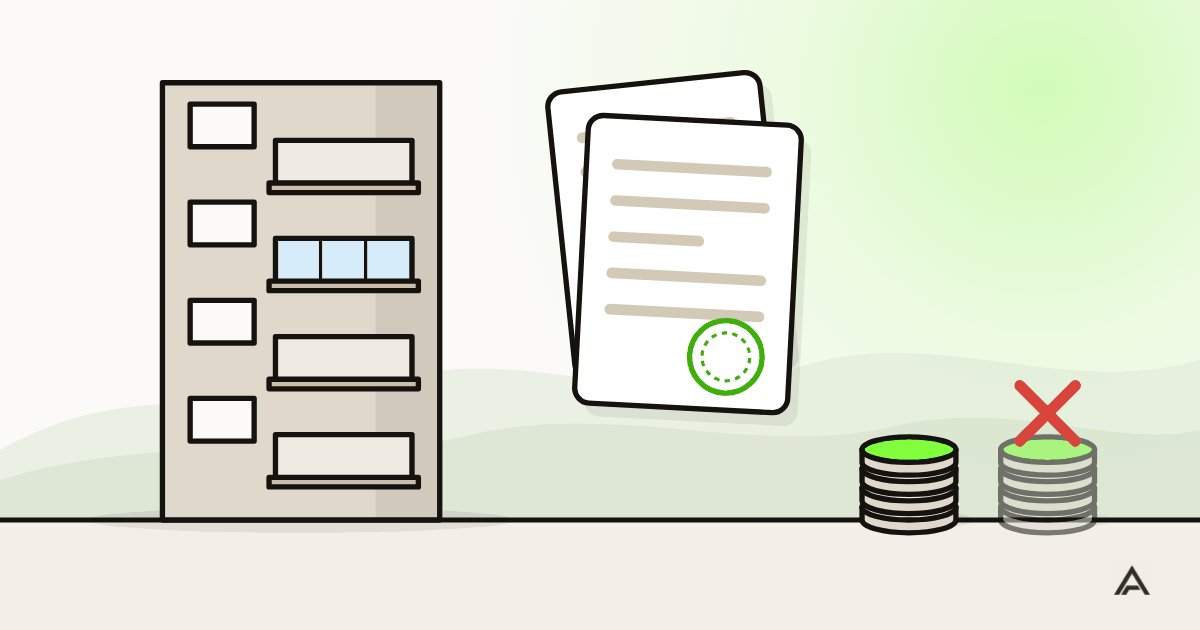
According to Order no. 1389/2026 of the Minister of Development, a balcony enclosed without a permit in a lawfully built block does not double the tax on the flat, can be regularised at any time at the ordinary fees, and can no longer be fined after 3 years, a period the text of the Code does not contain. The order was signed on 5 November 2026, published in Monitorul Oficial no. 932 of 6 November 2026, and approves instructions for article 301 of the Urbanism Code, for balcony enclosures only. It is an interpretative act, issued under article 578(2) of the Code.
Order 1389/2026 against the text of the Code
| The question | What the order says | What the Code says |
|---|---|---|
| Is the tax on the flat doubled? | No, for a balcony enclosed in a lawfully built block | Art. 301(11): the 100% increase applies to buildings executed without a permit or in breach of it |
| Until when can you apply to regularise? | At any time, with no deadline | Art. 301(2) covers balcony enclosures without extension onto public land, with no deadline; the year in paragraph (7) concerns other buildings |
| Which fees do you pay? | The ordinary fees, not ten times | Art. 301(8): the tenfold fees apply only to the one-year window in paragraph (7) |
| When does the fine lapse? | 3 years after the work was finished | Art. 357 sets no period for the fine; art. 571(2): 5 years for the fines in art. 570; art. 581(3) excludes Ordinance 2/2001 |
| Does the city hall take stock of balconies? | It has no duty to take general stock | The Code does not require an inventory of balconies |
What kind of act the order is
The order rests on article 578(2) of the Code, which lets the ministry issue orders, instructions and guides of a technical, interpretative or administrative nature needed for the uniform application of the Code. The instructions in its annex define themselves as an act of an interpretative and administrative nature and say that, through them, the application of the rules is clarified without any need to amend the law.
That matters when you rely on them. A minister’s order cannot change a law. It can say how the ministry reads the text and how city halls apply it, and city halls now have an official reading to work from. Our reading: the order is a strong argument before a city hall or a local tax office, but it does not bind a court, which reads the Code itself.
The instructions have three parts: the tax, the limitation period for fines, and the regime for balconies under article 301.
Is the tax doubled for an enclosed balcony?
No, says the order. Article 301(11) raises the building tax by 100% for buildings executed in breach of the building permit or without following the legal procedures, where they were not regularised before the Code came into force. The increase runs from the date the city hall records the situation and lasts until regularisation or demolition.
The instructions distinguish between a building built unlawfully and a lawfully built building on which a one-off job was done later, such as enclosing a balcony. The second does not become, because of the balcony, a building executed without a permit, so the increase does not apply. The order adds that local tax offices have no legal basis to apply the 100% rate to a flat merely because it has an enclosed balcony.
Our reading: the interpretation fits the text, which speaks of buildings executed without a permit, not of any unpermitted work. The order settles the case of a balcony in a lawfully built block. Its reasoning speaks generally of minor extensions or secondary adaptations to a lawfully built building, but its conclusion covers only balcony enclosures. For other small works, the argument works only by analogy.
Regularisation: no deadline and no tenfold fees
The order places the enclosed balcony in the permanent regularisation regime: the application can be made at any time, at the standard permit fees. The Code has two regimes for the regularisation permit:
- the permanent regime (the order’s name for it), in article 301(2): single-family houses, ground floor or ground floor plus one, of at most 150 sq m, annexes of at most 150 sq m, and balcony enclosure works without extension onto public land;
- the one-year window, in paragraph (7): any other building, until 25 August 2027, with state control levies and fees ten times higher (paragraph (8)).
The owner can apply to regularise at any time, not only until August 2027. The other conditions remain: the building must meet the essential requirements (paragraph (3)), which is shown by technical expert reports (paragraph (9)), and the city hall can ask for works to bring it into compliance (paragraph (10)). The fee is not multiplied by ten, but the expert reports still cost money.
Three differences of wording are worth knowing. The Code excludes from the permanent regime any enclosure extending onto public land. The order speaks only of public-land extensions of balconies at ground floor level. In practice the two almost always overlap, but the Code’s text is wider. Second, the order speaks of balconies and loggias and only of multi-storey residential buildings; the Code names only balconies and does not limit the type of building. Third, the order calls balcony enclosure a work of reduced importance. In the Code, that phrase describes buildings in consequence class CC1 (article 370(7)), not a type of work. The order uses it in another sense, as a label.
Does the fine lapse after 3 years?
The order says that carrying out works without a permit is a contravention with a general limitation period of 3 years from the end of the offence, under contravention law and building discipline rules. For a balcony enclosed more than 3 years ago, the right to impose the fine would have lapsed. The text of the Code, however, contains no 3-year period.
Article 581(3) says that, in applying the Code, Government Ordinance 2/2001, the general law on contraventions, does not apply. Article 357, the one with the fines for unpermitted works, sets no limitation period for the fine. The Code has a single period for fines: 5 years from the offence, in article 571(2), for the contraventions in article 570, among them an intervention on an existing building in breach of the permit rules (letter a)), fined by the ISC at 50,000-100,000 lei. Whether article 570 applies to a balcony is debatable, but no period in the Code is 3 years. The order does not name the act its period comes from.
The 3-year period existed in Legea 50/1991, which the Code repealed on 25 August 2026. Our reading: for a balcony enclosed before that date, the old rule may matter, because a new law does not apply retroactively, and the order relies on exactly that principle. For a balcony enclosed after 25 August 2026, the basis for the 3-year period remains unclear. We analyse the period separately in our article on whether unpermitted works lapse.
A lapsed fine does not make the balcony lawful. Nowhere does the order say that a balcony enclosed long ago no longer needs regularising. It only says the fine can no longer be imposed and that regularisation can be requested at any time.
What the order does not cover
The order answers the questions on the tax, the fine, regularisation and the inventory, but leaves others open.
- Future enclosures. The order concerns balconies already enclosed. For a new enclosure the Code has its own rules: a uniform enclosure of the balconies in a block goes by notification, while enclosing only your own balcony usually needs a permit. The steps are in enclosing a balcony: permit or notification.
- A particular case. The order says the Code coming into force does not oblige city halls to take general stock of balconies enclosed without a permit. Our reading: that does not stop them from recording a particular case.
Two more cases are left open. Article 301(2) excludes monuments and protected areas with wording that attaches grammatically to houses, and whether it also excludes balconies in those areas is unclear. And if the parapet or the wall between balcony and room was removed during the enclosure, the work may touch the structure, a case the order does not deal with.
Steps if your balcony was enclosed without a permit
- Find out whether the block was built with a permit. The order protects only lawfully built buildings.
- Note when the balcony was enclosed and keep whatever proves the date: invoices, the contract with the installer, photographs.
- If you receive a tax assessment with the increased tax for the balcony, rely on Order 1389/2026 and article 301(11) when you challenge it.
- If you want to regularise, the application and documents are described on the page on the regularisation permit. The fee is the ordinary one.
This article is analysis, not legal advice. The provisions cited are from Order 1389/2026, published in Monitorul Oficial no. 932 of 6 November 2026 (read from the signed copy published by the ministry and from a legal database, because the official portal did not respond at the time of writing), and from Legea 169/2026, published in Monitorul Oficial no. 661 of 10 August 2026 (with the rectification in Monitorul Oficial no. 862 of 14 October 2026). Romanian legal terms are kept in the original where the English would be misleading. Check your own situation with the issuing authority.