
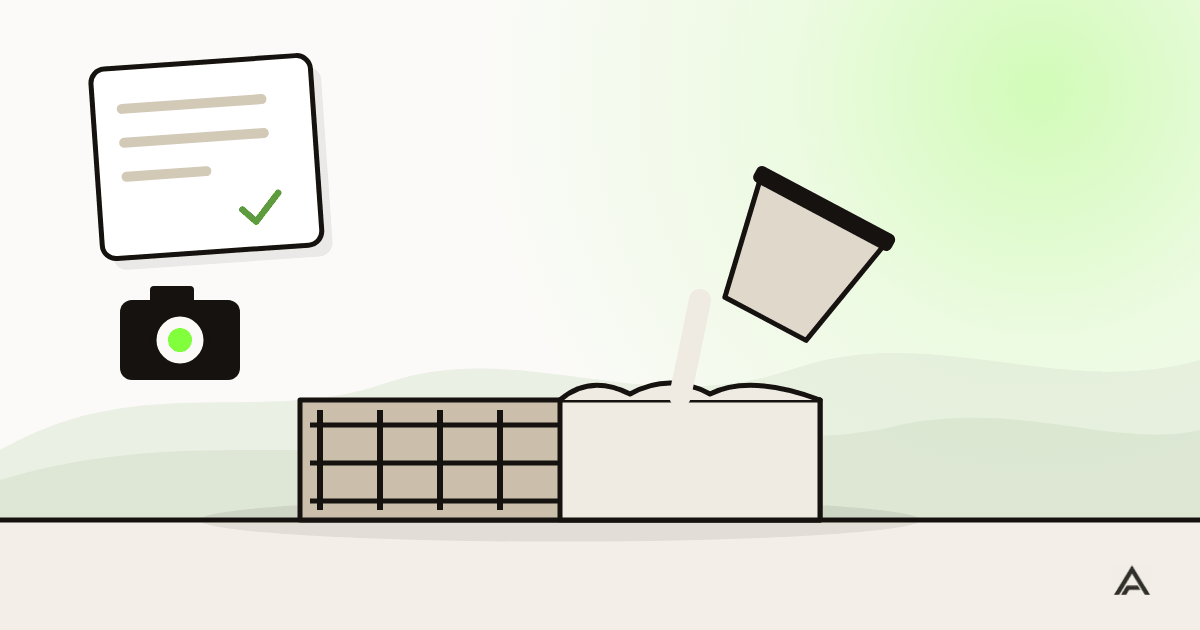
A hidden works record (proces-verbal de lucrări ascunse) states that part of a building was checked before the next stage covered it: the reinforcement before concreting, the trench before the foundation, the pipes before backfill or plaster. Once the concrete is poured, nobody can see what is underneath, so the paper stands in for the inspection. The Urbanism Code does not use the name and gives no template, but it treats the document as a condition for continuing the works after a critical phase, and the reception regulation, kept in force by the Code, names it outright.
In short
| The question | The answer | Source |
|---|---|---|
| Which law requires it now? | The Urbanism Code requires, at critical phases, documents attesting the quality […] of works that become hidden; the reception regulation calls them hidden works records | Legea 169/2026, art. 520(4)(b); Reception regulation, art. 15(3)(d) |
| Is there an official template? | Not in the Code and not among the 29 forms of Order 975/2026 | Order 975/2026 |
| Who follows the works? | The contractor’s technical lead (RTE), the site supervisor (diriginte de șantier), the designer at critical phases, the client | art. 520(3) |
| Where is it kept? | In the building’s technical book (cartea tehnică), with the execution documents; the site supervisor compiles the technical book | art. 456(1)(j), art. 529, art. 530(2)(a) |
| Who checks it at the end? | The committee for reception on completion | Reception regulation, art. 15(3)(d) |
| What if it is missing? | The committee suspends the reception and can ask for tests and expert reports | Reception regulation, art. 17(1)(e), art. 15(6) |
What hidden works are
Hidden works are the parts of a building that, once done, are covered by the next works and can no longer be seen without being opened up. Typical examples are the reinforcement in foundations, columns and slabs, waterproofing, buried pipes and the wiring inside walls. The record is drawn up before they are covered, on the basis of a check on site.
The term proces-verbal de lucrări ascunse comes from site practice and from the old regulations. The templates that circulate online almost all refer to Legea 10/1995 on quality in construction, most of which the Urbanism Code repealed (article 576(3)(c)). The Code kept the obligation, but in other words.
What the Urbanism Code says
The Code does not name the document, but at critical phases it requires documents attesting the quality of works that become hidden (article 520(4)(b)). Paragraph (3) of the same article says who must follow the works:
- the contractor, permanently, through its technical lead for execution (RTE);
- the developer, permanently, through the site supervisor or a consultant;
- the designer, at the critical phases, for every specialism;
- the control authority, the client or the client’s representatives, and the specialists involved in design.
Paragraph (4)(b) ties the document to state control. The construction inspectorate authorises the works to continue after a critical phase only if the designer, the contractor and the client have carried out the checks in the control programme and drawn up documents attesting the quality of the materials, the quality of the works that become hidden and the remedying of defects. The inspectorate’s procedure for these checks, PCF 002 (Order 1370/2014), uses the same wording in article 9(3)(d), and its template phase inspection report, in annex 3, lists among the documents checked those on the quality of works that become hidden. The procedure predates the Code.
We searched the whole Code for the word ascunse (hidden). Apart from hidden defects, in the articles on the liability of designers and contractors and on the warranty period (articles 424, 451 and 531), it appears only in this paragraph.
Signatures: who checks the covered layer
The Code gives no list of signatories for each hidden works record. For critical phases, article 520(4)(b) says the designer, the contractor and the developer or client draw up the attesting documents. For other works that become hidden, the Code only says who checks the works on site. The site supervisor takes part directly in the continuous checking of the works and writes non-conformity reports when the works do not match the design (article 456(1)(b) and (c)). The contractor’s technical lead has the same duty of continuous checking for the contractor and hands the execution documents to the developer for the technical book (article 459(1)(d) and (e)).
Our reading: outside critical phases, a document signed by the contractor’s technical lead and the client’s site supervisor is the minimum; at a critical phase the designer signs too, as the Code has the designer follow the works at those phases (article 520(3)(c)). The contract with the builder can ask for more, for example dated photographs attached to each record.
The difference from the critical phase report: that one is drawn up at points fixed in the design, with the designer and sometimes the inspectorate, as described in critical phases: the report and the ISC. Hidden works come up much more often, every time one layer covers another.
Where it ends up: the technical book and the reception
The site supervisor compiles the building’s technical book and the reception documents on the client’s behalf (article 456(1)(j)). The technical book is kept in electronic form and uploaded to the National Register of Buildings (article 529(2)), so the records no longer sit only in a binder.
At the reception on completion, the committee examines the documents in the technical book, including the updated as built design, the site instructions, the hidden works records and the critical phase reports. That is article 15(3)(d) of the reception regulation approved by HG 273/1994, which the Code keeps in force (article 577(6)). The page on reception on completion explains how the committee is convened and who sits on it.
If the records are missing
The reception regulation gives the committee three tools:
- It can ask, with reasons, for other documents, expert reports, additional tests, samples and measurements (article 15(6)).
- It suspends the reception if the client does not provide the required documents, the hidden works records among them (article 17(1)(e)).
- It also suspends the reception if it has reasonable doubts about the quality of the works and those doubts call for expert reports, tests and trials (article 17(1)(d)).
After a suspension, the deadline for remedying is set together with the contractor and cannot exceed 90 days (article 17(3)), with an extension of up to 90 days if weather or other factors beyond the parties’ control prevent the remedy (paragraph (5)). For work that is already covered, remedying usually means non-destructive testing, cores or opening up the layer locally. Who pays is set by the contract.
Where the work is done by the owner directly, which is allowed only for ground-floor rural homes, garages, terraces and ground-floor household annexes (article 279(1)), there is no separate contractor and so no contractor’s technical lead. Checking the works that become hidden stays with you and with the site supervisor or consultant (article 520(3)(b)). We cover the reception in this case separately: reception of a self-built house.
Before you cover any work
Get the list of works that become hidden from the site supervisor at the start of the job, stage by stage, and find out when they will be on site. The rule you can impose on the builder is simple: no concreting and no plastering until there is a signed record for the layer underneath. For reinforcement, ask for the measured dimensions to be written down, and attach dated photographs. The originals stay with you until the reception, and at the end you check that they all reached the technical book.
This article is analysis, not legal advice. The provisions cited are from Legea 169/2026, published in Monitorul Oficial no. 661 of 10 August 2026, from the Regulation on the reception of buildings approved by HG 273/1994 (the 2017 text) and from the ISC procedure PCF 002 (Order 1370/2014), which predates the Code. Romanian legal terms are kept in the original where the English would be misleading. Check your own situation with the issuing authority.