
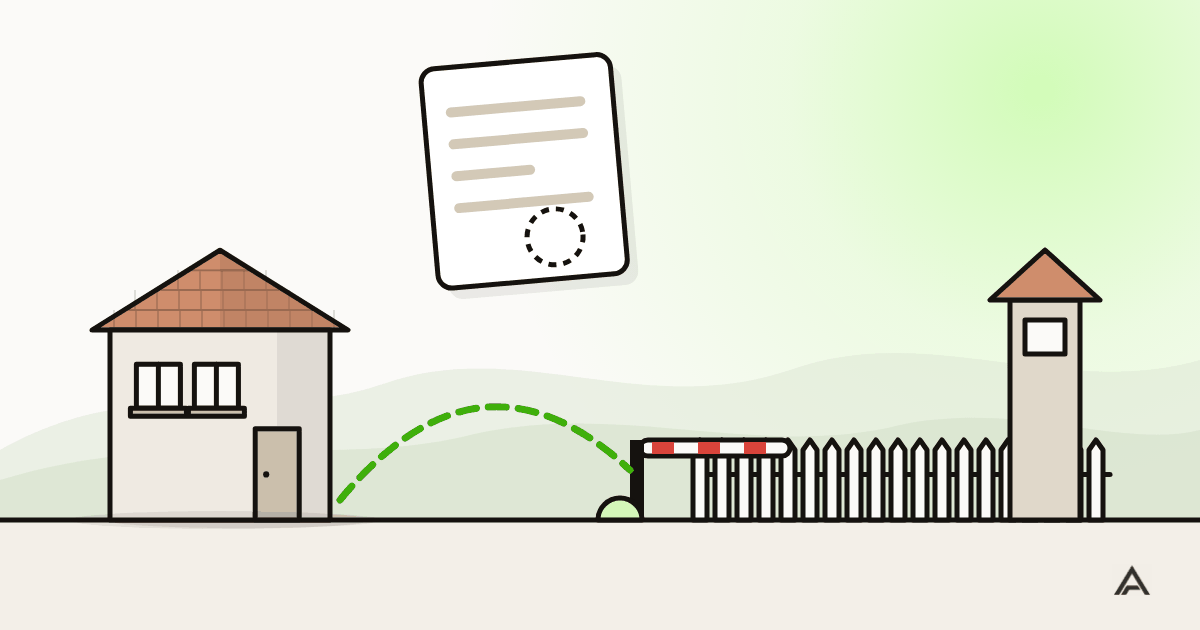
The certificat de urbanism asks you for the MApN aviz, issued by the Ministry of National Defence (Ministerul Apărării Naționale), when the plot is next to a military site or inside its protection zone, or when the works are on the list in HG 62/1996. The Urbanism Code (Legea 169/2026) names the ministry’s aviz only for certain aerodromes; otherwise it folds it into the aviz of the institutions of the national defence, public order and national security system, abbreviated SNAOPSN. Two things matter in practice. There is no tacit approval for this aviz, and the filing instructions the ministry publishes were still written for the laws repealed on 25 August 2026.
When the certificat de urbanism asks for the MApN aviz
The list of avize is set by the issuer of the certificat de urbanism, by location, complexity, degree of risk and type of works (art. 266(1)). The SNAOPSN aviz goes on the list for buildings near special-purpose buildings or inside their protection zones (art. 266(2)(c)). Article 349(e) says the same for zones set by urbanism documentation or communicated to the town hall by those institutions. Separately, HG 62/1996 requires the General Staff’s aviz for the works in the table below.
| Your situation | What is required | Where it is written |
|---|---|---|
| Plot next to a special-purpose building or inside its protection zone | The aviz of the SNAOPSN institution | Law 169/2026, art. 266(2)(c), art. 349(e) |
| Any building less than 2,400 m from a special site outside the built-up area | The aviz of the General Staff (MApN) | HG 62/1996, annex, point 4 |
| A building in the built-up area on a plot next to a military site or across the street from it | The aviz of the General Staff (MApN) | HG 62/1996, annex, point 4 |
| A borehole less than 500 m from a special site | The aviz of the General Staff (MApN) | HG 62/1996, annex, point 4 |
| Wind turbines, photovoltaic parks, fuel stations | The aviz of the General Staff (MApN) | HG 62/1996, annex, point 1; turbines and photovoltaic parks added by HG 119/2015 |
| The works require neighbours’ consent and the neighbouring property belongs to an SNAOPSN institution | The institution’s aviz and the neighbour’s consent | Law 169/2026, art. 261(1) |
You cannot see military zones on the ground. Annex 1 to the Code defines special-purpose zones, marked DS in the urbanism documentation, and their protection zones. Protection zones can also be set by administrative documents sent to the town hall, until the plans are updated. So even if the general urban plan (PUG) shows nothing near your plot, the certificate can still ask for the aviz: the town hall must take account of restrictions communicated officially when it issues certificates and sets the avize (art. 95(2)).
Who belongs to SNAOPSN
Annex 1 lists the institutions: the Romanian Intelligence Service, the Foreign Intelligence Service, the Protection and Guard Service, the Ministry of National Defence, the Ministry of Internal Affairs and the Ministry of Justice, through specialised internal structures, plus the National Administration of State Reserves and Special Problems. The MApN aviz is therefore only one of the SNAOPSN avize. Next to a gendarmerie unit or a prison, the certificate may ask for the aviz of another institution on the same list, under the same Code rules.
The Code names the Ministry of National Defence directly in few places, and its aviz in only one: civil aerodromes also used as bases for state aircraft. There, in zones subject to aeronautical servitudes, the aviz of the Romanian Civil Aeronautical Authority and of the ministry is required (art. 350(2)). For everything else, the basis is the general SNAOPSN wording.
What HG 62/1996 says
The decision approves the list of investments for which the aviz of the General Staff (Statul Major General) is mandatory. The ministry’s document described below, saved in 2018, calls it the Defence Staff (Statul Major al Apărării). The decision is not among the acts the Code repeals, which article 576(3) names one by one; otherwise the Code repeals only provisions contrary to it (art. 583(5)). The text used is the one in Monitorul Oficial no. 32 of 15 February 1996, plus HG 119/2015; we found no other amendments.
Point 4 matters most for a house. It requires the aviz for any building less than 2,400 m from special sites outside the built-up area. Inside the built-up area, point 4 requires the aviz for buildings on plots adjoining military sites and for those on the other side of the streets bordering their perimeter. The same point covers works on the bank of the Danube and within 2 km of the waterline on the coast, boreholes less than 500 m and quarries less than 1 km from special sites, silos and grain depots over 15 tonnes, other depots over 5,000 m³, land improvement works, deforestation and afforestation.
Points 1-3 cover industry, energy, transport and telecommunications. Since 2015 they include wind turbines and photovoltaic parks; fuel stations were on the list from 1996. The decision does not say where the special sites are, and we found no public list of them. Our reading is that, for the point 4 distances, the town hall can ask you for the aviz only if it knows of the site, from the PUG or from what it has been told (art. 95(2)).
No tacit approval
For most avize, an institution’s silence after the deadline counts as an aviz granted, and the permit can be issued on a sworn statement and, where relevant, proof that you answered the requests for completion (art. 269(14) and (16)). SNAOPSN avize are the exception: the documentation filed is not deemed complete and the aviz is not deemed issued when the deadlines run out (art. 269(15)). Without the institution’s written answer, the permit file cannot move on.
The general mechanism and the deadlines for each route are on the page about avize for the building permit. Why tacit approval shortens less than it seems is in what tacit approval actually shortens. If you choose the single-approval committee route, the SNAOPSN aviz can go through the committee too: article 269(1) excludes only letters f)-h), l) and m) of article 266(2), and the SNAOPSN aviz is letter c). Otherwise you file it yourself, as below.
What to file for the aviz
HG 62/1996 describes the file in point 5. The supporting statement gives the project, its purpose and phases, its dimensions and technical features, including the height of the lifting equipment used on site, the structural system and the legal status of the land. Then come the site location plan, with contour lines, and the site plan with spot levels. The site plan also shows the non-military buildings in the immediate vicinity, each with its maximum height. Since 2015 the certificat de urbanism is added (letter E).
The ministry publishes a document listing the papers by type of documentation. The version we found was saved in December 2018. For a building permit it asks for: the application, a copy of the certificat de urbanism, the title documents, the supporting statement, the site location plan, the site plan and, where needed, the plan of underground structures. Files go in a single copy, except those for wind farms (three) and radio towers (two). The correspondence address in the document is that of a military unit of the ministry, str. Izvor nr. 110, sector 5, Bucharest. The same document says no fee is charged for the aviz.
The document still refers to Legea 50/1991 and Legea 350/2001, both repealed, and to the D.T.A.C., a file replaced by the PAC, the project for the building permit. The Code gives every aviz issuer 120 days from publication, that is until around 8 December 2026, to update procedures written for the old laws (art. 583(4)). Until the new version appears, confirm the list with the military unit that gives the aviz before you send the file.
When your neighbour is a military unit
Article 261(1) requires neighbours’ consent when the works call for measures to make existing buildings safe, identified by the technical assessment. In the same paragraph, if the neighbouring property belongs to an SNAOPSN institution, you need both the institution’s aviz and the neighbour’s consent.
The general cases are in neighbours’ consent.
Nor does notification get around the restrictions around these properties. Works that would be done by notification are barred from that route if they breach the specific requirements of special-purpose properties of SNAOPSN institutions (art. 297(6)). Next to a military unit, check whether your works qualify for notification and then whether they meet the special requirements of the neighbouring property; if they do not, you need a permit.
If the aviz is in your certificate and you cannot see why
The Code forbids asking for avize that have no legal and technical basis in relation to the works (art. 266(4)). Our reading is that you can ask the issuer of the certificate what the request rests on: a DS zone in the PUG, a restriction communicated officially (art. 95(2)) or a point of HG 62/1996. The answer also tells you which institution gives the aviz. If the basis exists, the aviz stays mandatory: without the written aviz you do not get the permit.
The steps, briefly
- Read the list of avize in the certificat de urbanism and look for the SNAOPSN or MApN aviz.
- If you do not understand why it is there, ask the town hall for the basis: the PUG zone, the communicated restriction or the point of HG 62/1996.
- Prepare the supporting statement and plans with the levels and heights required by HG 62/1996, point 5, plus the certificat de urbanism.
- Confirm the list of documents and the address with the military unit that gives the aviz, because the published instructions predate the Code.
- Do not count on tacit approval: without the written aviz, the permit file stands still.
This article is analysis, not legal advice. The provisions cited are from Legea 169/2026, published in Monitorul Oficial no. 661 of 10 August 2026, and from HG 62/1996, with the amendments made by HG 119/2015. The filing instructions published by the Ministry of National Defence predate the Code. Romanian legal terms are kept in the original where the English would be misleading. Check your own situation with the issuing authority.